Oil painting -> List of Painters -> Rockwell Kent
Rockwell Kent
 |
Early Days: |
Career:
Kent's early paintings of Mount Monadnock and New Hampshire were first shown at the Society of American Artists in New York in 1904, when Dublin Pond was purchased by Smith College. In 1905 Kent ventured to Mohegan Island, Maine, where he based himself for the next five years. His first series of paintings of Mohegan were shown in 1907 at Clausen Galleries in New York to wide critical acclaim, and they form the foundation of his lasting reputation as an early American modernist. Among those lauding Kent was critic James Huneker of the Sun (who would soon deem the paintings of The Eight to be "decidedly reactionary"). Huneker praised Kent's brushwork as athletic and his colorful dissonances as daring. A transcendentalist and mystic in the tradition of Thoreau and Emerson whose works he read, Kent found inspiration in the austerity and stark beauty of wilderness. After Monhegan, he lived for extended periods of time in Newfoundland (1914-15), Alaska (1918-19), Tierra del Fuego (1922-23), Ireland (1926), and Greenland (1929; 1931-32; 1934-35).
|
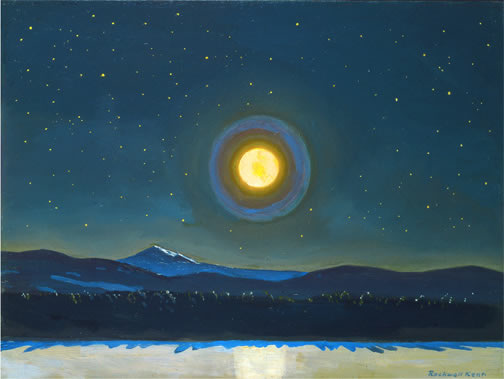
In 1918-19 Kent and his nine year-old son ventured to the American frontier of Alaska. Wilderness (1920), the first of Kent's several adventure memoirs, is an edited and illustrated compilation of his letters home. Upon the artist's return to New York in 1919, publishing scion George Palmer Putnam and others, including Juliana Force—assistant to Gertrude Vanderbilt Whitney—implemented their avant-garde notion of incorporating the artist as "Rockwell Kent, Inc." to support him in his new Vermont homestead while he completed his paintings from Alaska for exhibition in 1920 at Knoedler Galleries in New York. Kent's small oil on wood panel sketches from Alaska—uniformly horizontal studies of light and color—were exhibited at Knoedler's as "Impressions." Their artistic lineage to the small and spare oil sketches of James Abbott McNeill Whistler (1834-1903), which are often entitled "Arrangements," underscores Kent's admiration of Whistler as a "genius."