Oil painting -> List of Painters -> Cecilia Beaux
Cecilia Beaux
 |
Early Days: |
Career:
Her childhood was a sheltered though generally happy one. As a teen she already manifested the traits, as she described, of “both a realist and a perfectionist, pursued by an uncompromising passion for carrying through.” She attended the Misses Lyman School and was just an average student, though she did well in French and Natural History. However, she was unable to afford the extra fee for art lessons. At the age of sixteen, Beaux began art lessons with a relative, Catharine Ann Drinker, an accomplished artist who had her own studio and a going clientele. Drinker became Beaux’s role model, and she continued lessons with Drinker for a year. She then studied for two years with the painter Francis Adolf Van der Wielen, who offered lessons in perspective and drawing from casts during the time that the new Pennsylvania Academy of the Fine Arts was under construction. Given the bias of the Victorian age, female students were denied direct study in anatomy and could not attend drawing classes with live models (who were often prostitutes) until a decade later.
At eighteen, Beaux was appointed drawing teacher at Miss Sanford's School, taking over Drinker’s post. She also gave private art lessons, and produced decorative art and small portraits. Her own studies were mostly self-directed. Beaux received her first introduction to lithography doing copy work for Philadelphia printer Thomas Sinclair and she published her first work in St. Nicholas magazine in December 1873. Beaux demonstrated accuracy and patience as a scientific illustrator, creating drawings of fossils for Edward D. Cope, for a multi-volume report sponsored by the U.S. Geological Survey. However, she did not find technical illustration suitable for a career (the extreme exactitude required gave her pains in the “solar plexus”). At this stage, she did not consider herself an artist as yet.
|
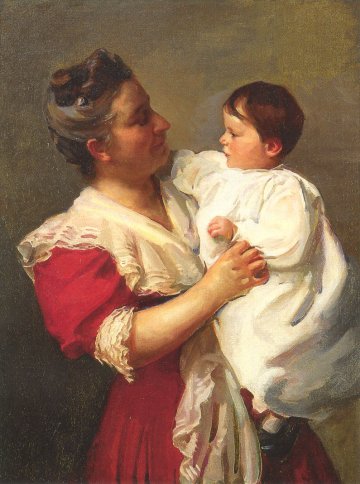
Beaux began attending the Pennsylvania Academy of the Fine Arts in 1876, then under the dynamic influence of Thomas Eakins, whose great work The Gross Clinic had “horrified Philadelphia Exhibition-goers as a gory spectacle” at the Centennial Exhibition of 1876. She steered clear of the controversial Eakins, though she much admired his work. His progressive teaching philosophy, focused on anatomy and live study (and allowed the female students to partake in segregated studios), eventually led to his firing as director of the Academy. She did not ally herself with Eakins' rabid student supporters, and later wrote, “A curious instinct of self-preservation kept me outside the magic circle.” Instead, she attended costume and portrait painting classes for three years taught by the ailing director Christian Schussele.