Frank Stella
Frank Philip Stella (born May 12, 1936) is an American painter. He is a significant figure in minimalism and post-painterly abstraction.
Stella was born in Malden, Massachusetts. He studied painting at the Phillips Academy in Andover, Massachusetts and later studied history at Princeton University.
He became influenced by the abstract expressionism of Jackson Pollock and Franz Kline. However, upon moving to New York City around the late 1950s, he reacted against the expressive use of paint by most painters of that movement, instead finding himself drawn towards the "flatter" surfaces of Barnett Newman's work and the "target" paintings of Jasper Johns.
He began to produce works which emphasized the picture-as-object, rather than the picture as a representation of something, be it something in the physical world, or something in the artist's emotional world. Around this time he said that a picture was "a flat surface with paint on it - nothing more".
This new aesthetic found expression in a series of paintings in which regular bands of black paint were separated by very thin white pinstripes of unpainted canvas. Die Fahne Hoch! (1959) is one such painting. It takes its name ("The Raised Banner" in English) from an anthem of the Hitler Youth, and Stella pointed out that it is in the same proportions as banners used by that organization. It has been suggested that the title has a double meaning, referring also to Jasper Johns' paintings of flags. In any case, its emotional coolness belies the contentiousness its title might suggest, reflecting this new direction in Stella's work.
As well as their influence on other painters, these paintings were an important influence on the development of minimalist sculpture. Stella was a friend of two of the most significant figures in that field, Carl Andre and Donald Judd.
From 1960 he began to produce paintings in aluminum and copper paint which, in their presentation of regular lines of color separated by pinstripes, are similar to his black paintings. However they use a wider range of colors, and are his first works using shaped canvases (canvases in a shape other than the traditional rectangle or square), often being in L, N, U or T-shapes. These later developed into more elaborate designs, in the Irregular Polygon series of the mid-1960s, for example.
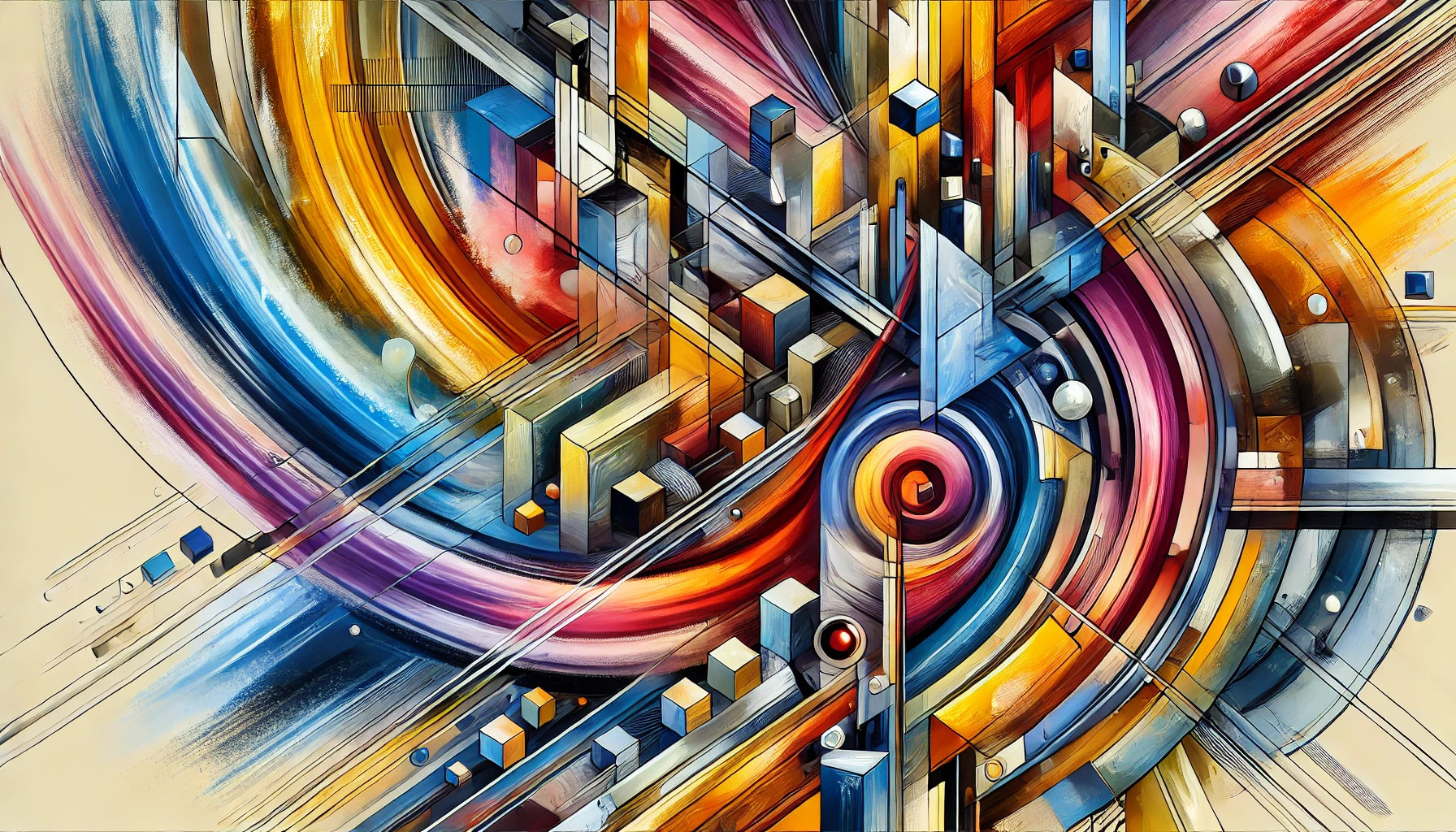
Also in the 1960s, Stella began to use a wider range of colors, typically arranged in straight or curved lines. In 1967 he began his Protractor Series of paintings, in which arcs, sometimes overlapping, within square borders are arranged side-by-side to produce full and half circles painted in rings of concentric color. These paintings are named after circular cities he had visited while in the Middle East earlier in the 1960s.
In the 1970s Stella's style underwent a dramatic change. The carefully constructed geometric designs executed in flat planes of color were replaced by a "looser" style sometimes reminiscent of graffiti. The shaped canvases took on even less regular forms in the Eccentric Polygon series, and elements of collage were introduced, pieces of canvas being pasted onto plywood, for example. His work also became more three-dimensional to the point where he started producing large, free-standing metal pieces, which, although they are painted upon, might well be considered sculpture.
Stella has gone on to produce a number of large works for public spaces, and the three-dimensionality of his work has led to him being commissioned to produce architecture, including a bandshell for the city of Miami, Florida.
Stella continues to produce works in this style
and lives in New York City.