Oil painting -> List of Painters -> Boris Kustodiev
Boris Kustodiev
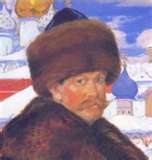 |
Early Life: Boris-Kustodiev Boris Kustodiev was born in Astrakhan into the family of a professor of philosophy, history of literature, and logic at the local theological seminary His father died young, and all financial and material burdens fell on his mother's shoulders The Kustodiev family rented a small wing in a rich merchant's house. It was there that the boy's first impressions were formed of the way of life of the provincial merchant class. The artist later wrote, "The whole tenor of the rich and plentiful merchant way of life was there right under my nose... It was like something out of an Ostrovsky play." The artist retained these childhood observations for years, recreating them later in oil and water-colours. |
Career:
The Russian Revolution of 1905 which shook the foundations of society, evoked a vivid response in the artist's soul. He contributed to the humorous journals Zhupel (Bugbear) and Adskaya Pochta (Hell’s Mail). At that time, he first met the artists of Mir Iskusstva (World of Art), a group of innovative Russian artists. He joined their association in 1910 and later took part in all their exhibitions.
In 1905, Kustodiev first turned to book illustrating, a type in which he worked throughout his entire life. He illustrated many works of classical Russian literature, including Nikolai Gogol’s Dead Souls, The Carriage, and The Overcoat; Mikhail Lermontov's The Lay of Tsar Ivan Vasilyevich, His Young Oprichnik and the Stouthearted Merchant Kalashnikov; and Leo Tolstoy's How the Devil Stole the Peasants Hunk of Bread and The Candle.
|

In 1909, he was elected into Imperial Academy of Arts He continued to work intensively, but a grave illness—tuberculosis of the spine—required urgent attention.On the opinion of his doctors he went to Switzerland, where he spent a year undergoing treatment in a private clinic. He pined for his distant homeland, and Russian themes continued to provide the basic material for the works he painted during that year. In 1918, he painted The Merchant's Wife, which became the most famous of his paintings.