Oil painting -> List of Painters -> Samuel Prout
Samuel Prout
 |
Early Days: |
Career:
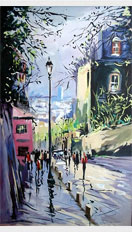
It was not however until about 1818 that Prout discovered his niche. Happening time to make his first visit to the Continent, and to study the quaint streets and market-places of continental cities, he suddenly found himself in a new and enchanting province of art. His eye caught the picturesque features of the architecture, and his hand recorded them with skill. The composition of his drawings was exquisitely natural; their colour exhibited "the truest and happiest association in sun and shade"; the picturesque remnants of ancient architecture were rendered with the happiest breadth and largeness, with the heartiest perception and enjoyment of their time-worn ruggedness; and the solemnity of great cathedrals were brought out with striking effect.
|

Having established his reputation with these street scenes, and gaining praise from John Ruskin, he was made 'Painter in Water-Colors in Ordinary' to King George IV in 1829 and afterwards to Queen Victoria.
At the time of his death there was hardly a place in France, Germany, Italy (especially Venice) or the Netherlands where his face had not been seen searching for antique gables and sculptured pieces of stone. He died after a stroke at his home at Denmark Hill, London and was buried at West Norwood Cemetery.