Oil painting -> List of Painters -> Sir Henry Raeburn
Sir Henry Raeburn
 |
Early Days: |
Career:
In his early twenties, he was asked to paint the portrait of a young lady whom he had previously observed and admired when he was sketching from nature in the fields. She was the daughter of Peter Edgar of Bridge lands, and widow of Count Leslie. Fascinated by the handsome and intellectual young artist, she became his wife within a month, bringing him an ample fortune. The acquisition of wealth did not affect his enthusiasm or his industry, but spurred him on to acquire a thorough knowledge of his craft. It was usual for artists to visit Italy, and Raeburn set off with his wife.
|
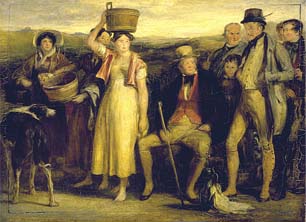
In London he was kindly received by Sir Joshua Reynolds, who advised him on what to study in Rome, especially recommending the works of Michelangelo. Raeburn carried with him to Italy many valuable introductions from the president of the Royal Academy. In Rome he met Gavin Hamilton, Pompeo Girolamo Batoni and Byers, an antique dealer whose advice proved particularly useful, especially the recommendation that "he should never copy an object from memory, but, from the principal figure to the minutest accessory, have it placed before him." After two years of study in Italy he returned to Edinburgh in 1787, and began a successful career as a portrait painter. In that year he executed a seated portrait of the second Lord President Dundas.