Oil painting -> Abraham Lincoln
Abraham Lincoln
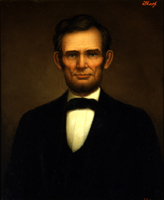
Abraham Lincoln Biography of Abraham Lincoln |
Biography of Abraham Lincoln
Abraham Lincoln, 16th president of the United States, guided the
nation through its devastating Civil War and remains much beloved
and honored as one of the world's great leaders. Lincoln was born
in Hardin (now Larue) County, Kentucky. He moved with his family
to frontier Indiana in 1816, and then to Illinois in 1830. After
serving four terms in the Illinois legislature, Lincoln was elected
as a Whig to the U.S. House of Representatives in 1846. He did not
seek reelection and returned to Springfield, Illinois, where he
established a statewide reputation as an attorney. Although unsuccessful
as a Whig candidate for the U.S.
Senate in 1855, Lincoln was the newly formed Republican Party's
standard-bearer for the same seat three years later. In that race,
Lincoln captured national recognition by engaging Democrat Stephen
A. Douglas in a dramatic series of public debates, but Lincoln ultimately
lost to Douglas on election day. In 1860 Lincoln was elected the
nation's first Republican president. By the time of his inauguration
in March 1861, seven Southern states had seceded from the Union,
formed their own separate government, and inaugurated Jefferson
Davis as its president. Concerned with preserving the Union from
dissolution, Lincoln presented an inaugural address that was conciliatory
in nature, assuring that slavery would not be abolished where it
then existed.
But one month later, when Confederate forces opened fire on Charleston's
Fort Sumter while Congress was in recess, Lincoln acted decisively.
He called up the militia; proclaimed a blockade; and suspended the
writ of habeas corpus, which ensures a citizen's right to be brought
before a court before imprisonment. The war that ensued lasted for
four years, during which time Lincoln assumed greater executive
power than any previous U.S. president. Of all Lincoln's actions
during the Civil War, he is perhaps best remembered for the Emancipation
Proclamation, which he issued on January 1, 1863.
Although it did not abolish slavery nationwide, it put slaveholders
on notice and gave the conflict an undeniable moral imperative.
When Lincoln was reelected in 1864, the war's end was in sight,
and the president urged leniency toward the Southern states. His
plan for postwar reconstruction advocated the forming of new state
governments that would be loyal to the Union, a plan later adopted
by President Andrew Johnson. Lincoln's presidency ended abruptly
when he was shot by John Wilkes Booth on April 14, 1865, in Washington,
D.C.'s Ford's Theater. Lincoln died the following day.
For Further Information Please Visit This Site: http://www.senate.gov