Oil
painting -> America's First Moon Landing
America's First Moon Landing
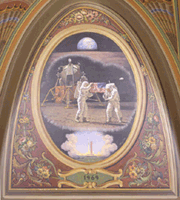
America's First Moon Landing, July 21, 1969
by Allyn Cox (1896 - 1982)
Oil on canvas, 1975
Sight (oval) measurement
Height: 34 inches (86.4 cm)
Width: 18 inches (45.7 cm)
Signature (lower right): Allyn Cox
Cat. no. 35.00001.000
History of America's First Moon Landing
This oval mural commemorating America’s Moon landing embellishes
the Brumidi Corridors in the Senate wing of the Capitol. The
mural’s three main elements are: the rocket that propelled
the astronauts into orbit; astronauts Neil Armstrong and Buzz
Aldrin planting the United States flag on the Moon, with the
lunar module Eagle in the background and the space capsule
Columbia circling the Moon; and a view of Earth as seen from
the Moon. Although the Eagle landed on the Moon in the afternoon
of July 20, Armstrong and Aldrin did not erect the flag until
the next morning, which explains why the scene is dated July
21, 1969.
Muralist Allyn Cox painted the work. The son of artists Kenyon
and Louise King Cox, Allyn Cox was born in New York City.
He was educated at the National Academy of Design and the
Art Students League in New York, and the American Academy
in Rome. Cox began receiving commissions for murals after
his return from Italy in 1920. His earliest public works are
in the collections of the William A. Clark Library in Los
Angeles and the University of Virginia Law School in Charlottesville.
In 1972 the U.S. Senate Commission on Art directed that a
mural commemorating the Moon landing be commissioned and placed
in the Capitol’s Brumidi Corridors, which were originally
decorated between 1857–78 by Italian-born fresco painter Constantino
Brumidi, who left several areas unfinished. In 1974 Cox prepared
and submitted his design for America’s First Moon Landing,
July 21, 1969. He received advice and assistance on artistic
and technical decisions from museum professionals at the National
Aeronautics and Space Administration (NASA), the Smithsonian
Institution’s National Air and Space Museum and National Portrait
Gallery, and the U.S. Capitol. Cox executed the final work
on canvas in his studio and in April 1975 the mural was completed
and installed.
Earlier, in 1952, Cox rendered scenes to fill out the last
three panels of the panoramic frieze in the Capitol Rotunda.
From 1973 until his retirement in 1982, Cox painted the ceilings
of the Capitol’s first floor House corridors with scenes depicting
the development of Congress and the growth of the nation.
This work was completed by his assistant, Clifford Young.
In remarks in the Congressional Record that year, Cox was
hailed as “the American Michelangelo” for his Capitol murals.
[1] The artist is also represented in the U.S. Senate by a
portrait of Henry Clay in the Senate Reception Room.
|
History of America's First Moon Landing
Apollo 11, which was launched into space from the Kennedy Space Center, Florida, began its epic voyage to the Moon on July 16, 1969. On board were Commander Neil A. Armstrong, Lunar Module Pilot Edwin E. "Buzz" Aldrin, Jr., and Command Module Pilot Michael Collins. After 24 hours in lunar orbit, the command/service module, Columbia, separated from the lunar module, Eagle. Armstrong and Aldrin began their descent to the lunar surface in the Eagle while Collins stayed behind to pilot the Columbia. The lunar module touched down on the Moon at Tranquility Base on July 20, 1969, at 4:17 p.m. edt. Armstrong reported, "The Eagle has landed."
At 10:56 p.m., Armstrong stepped onto the lunar surface, becoming the first person to walk on the Moon. "That's one small step for man, one giant leap for mankind," declared Armstrong. Aldrin then followed Armstrong, and the two men conducted a variety of tasks and experiments. They later rejoined the Columbia, and the entire crew returned to Earth, landing in the Pacific Ocean southwest of Hawaii on July 24. The Apollo 11 mission was the culmination of a decade of human space exploration.
The space program and the dream of landing a man on the Moon gained momentum during the 1960s, following President Kennedy's historic speech before Congress on May 25, 1961. On that day, Kennedy proposed: "I believe that this Nation should commit itself to achieving the goal, before this decade is out, of landing a man on the moon and returning him safely to the earth."1 Five months and 10 days before the end of the decade, Armstrong and Aldrin fulfilled Kennedy's goal for the nation.
For Further Information Please Visit This Site: http://www.senate.gov/