-
Oil Painting
»
-
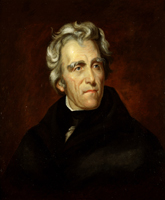
Andrew Jackson
Andrew Jackson
Andrew Jackson
by Thomas Sully (1783 - 1872) (attributed)
Oil on canvas, mounted on board, 1857 ca.
Sight measurement
Height: 29.25 inches
(74.3 cm)
Width: 24.25 inches (61.6
cm)
Unsigned
Cat. no. 32.00018.000
Biography of Andrew Jackson
In 1824 Thomas Sully painted a study portrait from life of
Andrew Jackson. The hero of the Battle of New Orleans was
by then a U.S. senator and a Democratic nominee for president.
Two decades later, Jackson's ill health prompted Sully to
copy his 1824 study portrait; the replica, which closely resembles
the study, was completed shortly before Jackson's death in
April 1845. It is now owned by the National Gallery of Art
in Washington, D.C. Sully used the replica as a model to create
a full-length portrait of Jackson as the battle hero (this
painting is now owned by the Corcoran Gallery of Art in Washington,
D.C.). The National Gallery's portrait was long assumed to
be the original 1824 life study until it was discovered that
the artist had not purchased the linen on which it was executed
until the mid-1830s. The original 1824 study was privately
owned by Mrs. Breckenridge Long in 1940, but its current location
is unknown.
The portrait now in the U.S. Senate was painted several years
after Sully's other Jackson portraits, probably in the late
1850s. Though it is clearly based on the 1824 and 1845 likenesses,
it differs from these works in three distinct ways. First,
the canvas is considerably larger, a result of a later mounting
of the original canvas on another, increasing the size by
four inches at the sides and top and by six inches at the
bottom. This expansion necessitated painting an addition:
the dark cloak below the collar (which has darkened into an
undefined mass). Second, the pose is slightly altered. The
characterization shifts from poetic and introspective to vigorous
and engaged. The head tilts more, throwing the chin completely
out of the vertical centerline.
The chin also is painted more emphatically, with a strong
highlight, which subtly alters the appearance of the face
when compared with the 1824 and 1845 Sully paintings. Third,
Sully's mature style, as seen in the 1824 and 1845 Jackson
portraits, is not congruent with that of the Senate painting.
In the latter, the paint surface is built up and emphatic,
exaggerating the appearance of the hair and the eyebrows,
as well as the chin, creased cheek, and forehead. In contrast,
Sully's 1824 and 1845 Jacksons are painted with a light touch–-a
fluidity of brushwork that creates an effect of transparency.
In the Senate painting, one finds repeated shapes and insistent
rhythms (for instance, in Jackson's hair) that are not found
in the earlier portraits and do not seem typical of Sully.
In addition, the skin tone is swarthy, a tone not typical
of the artist or, for that matter, of Jackson. Engraver Thomas
B. Welch introduced many of the stylistic exaggerations found
in the Senate painting (especially in the hair, eyebrows,
and facial furrows) in his 1852 engraved copy of Sully's earlier
likenesses. Although Sully might have replicated an engraving
of his own painting, it is also possible that the Senate painting
was copied from Welch's engraving by another, unidentified
artist. The provenance of the Senate painting, on the other
hand, appears to support an attribution to Sully. On June
6, 1872, Garrett C. Neagle, son of the artist John Neagle
and grandson of Thomas Sully, wrote to Architect of the Capitol
Edward Clark to confirm receipt of two Sully paintings that
Garrett Neagle had sent to the Joint Committee on the Library.
The paintings, a portrait of Andrew Jackson and one of Thomas
Jefferson, "painted by Mr. Thos. Sully in the years 1856 and
7," were being offered for sale by Neagle for $300 each. According
to Neagle, the Jackson portrait was "painted from studies
taken from life" and was considered a fine likeness of the
former president. After Sully's death on November 5, 1872,
Neagle wrote that the portraits now "should be worth to Congress,
at least $500 each." Clearly, Garrett Neagle had no doubt
about the authenticity of the portraits, although he stood
to benefit financially from their sale. The Joint Committee
on the Library considered the matter at leisure and in May
1874 purchased the Jefferson portrait (for only $200) and
returned the Jackson painting to Neagle. Half a century after
Neagle's first offer, a New York art firm offered the Jackson
portrait again to the U.S. government. This time the Joint
Committee on the Library authorized its purchase on March
1, 1922, for $1,200.
Andrew Jackson was a national hero for his defeat of the British
at New Orleans in the War of 1812. He was born in what is today
Lancaster County, South Carolina, and later moved to what is now
Nashville, Tennessee. In 1796, after serving as a delegate to Tennessee's
first Constitutional Convention, Jackson was the first person elected
to the U.S. House of Representatives from the state of Tennessee.
The following year, he won a seat in the U.S. Senate but soon resigned
for personal and financial reasons. From 1798 to 1804 he served
as a superior court judge in Tennessee, then retired to live the
life of a country gentleman. When war broke out in 1812, Jackson
returned to public life as a military leader and rose to the rank
of major general.
His 1815 defeat of the British at the Battle of New Orleans won
him widespread fame; he became the South's great hero and was affectionately
known as "Old Hickory." After serving briefly as governor of Florida
when it was admitted as a new U.S. territory in 1821, Jackson returned
to the Senate and in 1824 ran for president against Henry Clay,
John Quincy Adams, and William Crawford. The House of Representatives
decided the election in favor of Adams, because no candidate had
an electoral majority. Jackson possessed the largest popular vote,
but he narrowly lost the election despite his supporters' charges
of a "corrupt bargain" between the Clay and Adams adherents.
Four years later, Jackson was elected to the first of two terms
as the seventh president of the United States. Beloved by his supporters
as a champion of the common man, Jackson met with controversy during
both of his terms. A principal topic early in his administration
was nullification, as South Carolinians threatened to nullify federal
tariffs they found oppressive–-or secede if not permitted to do
so. The president made clear that he stood firmly for the Union,
and he fought hard to pass a tariff act to resolve the issue. The
debate over nullification and states' rights continued into the
1832 presidential campaign, and only eased the following year with
the passage of a compromise tariff engineered by Henry Clay. Jackson's
long fight against a bill to recharter the Bank of the United States
was also a source of political conflict during the 1832 campaign.
His anti-bank stance appeared democratic to voters, however, and
Jackson was elected to a second term, defeating Henry Clay, who
supported a national financial institution. Jackson, who wanted
to ensure the demise of the bank, subsequently withdrew federal
monies and deposited them in state banks, an action thought to have
contributed to the economic Panic of 1837. In addition, Jackson
would later receive criticism when thousands of Native Americans
were forced to relinquish their land and relocate to Indian Territory
(now Oklahoma). A strong chief executive who expanded the power
of the presidency, Jackson also exerted significant influence over
the Democratic Party. After dictating his choice of a successor
(Martin Van Buren), Jackson retired to his country home, the Hermitage,
near Nashville. He died there in 1845.
For Further Information Please Visit This Site: http://www.senate.gov/