- Oil Painting »
- List of Painters »
- John Caldwell Calhoun
John Caldwell Calhoun
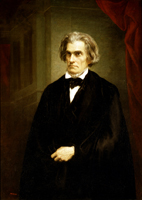
John C. Calhoun by Henry Darby
by Henry F. Darby (1829 - 1897)
Oil on canvas, 1858 ca.
Sight measurement
Height: 49.75 inches
(126.4 cm)
Width: 35.63 inches (90.5
cm)
Signature (lower left corner): H. F. DARBY
Cat. no. 32.00003.000
Biography of John Caldwell Calhoun
America's premier 19th-century photographer, Mathew B. Brady,
sold this painting of John C. Calhoun by Henry Darby to the
federal government in 1881. Financial reversals had forced
Brady to part with this and two other prized oils, those of
Henry Clay and Daniel Webster. The three had hung together
in a prominent position in Brady's elegant photographic gallery
on the corner of Broadway and Tenth Street, in New York City.
Of the Calhoun portrait, an impressed New York Times reviewer
noted, "The ragged, wiry character of the face marking nervous
energy, [and] the overhanging brow and broad intellectual
development [capture] Calhoun at a glance." [1] In 1849 or
1850, shortly before his death, John C. Calhoun and his daughter,
Florence Clemson, had stopped by Brady's gallery to have a
daguerreotype made.
The picture was intended to satisfy his granddaughter's request
for an image of him for her locket. Calhoun, now nearing 70,
had lost his youthful vigor. Wrote Brady: "His hair, which
in his younger days had been dark, and had stood frowningly
over his broad, square forehead, was now long and thin and
combed back, falling behind his ears. His most outstanding
feature was his eye which startled and almost hypnotized me!"
During intervals of posing, Brady noted that Calhoun's daughter
"delicately arranged her father's hair and the folds of his
coat...." [2] Later, Brady was to claim that artist Henry
Darby had been present for the photography session, making
a study for the painting. The evidence is fairly convincing,
however, that Darby based his portrait on an existing Brady
daguerreotype rather than on direct studies from life.
The two often teamed up in this fashion, using a process by
which glass negative copies of the daguerreotypes were projected
onto sensitized canvas, then "enhanced" with oil paint. The
inscription on the reverse of the canvas–-"Calhoun / from
Life by Darby / H. F. Darby / 1858"–-appears to be contradictory.
Calhoun died in 1850, making an 1858 life portrait an impossibility.
By 1858, Darby's studio and Brady's photographic gallery were
located within the same block of Pennsylvania Avenue in Washington,
D.C. No reference to the oil portrait occurs until that year,
when it was exhibited at Brady's National Photographic Art
Gallery in Washington, D.C., and again in 1859, when it was
shown in New York City at the National Academy of Design.
In 1860, one year later, the painting was displayed in Brady's
New York Gallery on Broadway.
Therefore, it is likely that the inscription date is correct
and that the painting was indeed made from Brady's daguerreotype,
instead of from life. Henry Darby led a varied career, from
self-taught portraitist to ordained minister. Records also
indicate that he was an art teacher, served on the National
Arts Committee in Washington, D.C., and designed religious
altarpieces and clerical attire. While few of his portraits
and none of his later historical and religious paintings survive,
his work can be found in the collections of the Museum of
Fine Arts, Boston, and the Munson-Williams-Proctor Institute
Museum of Art in Utica, New York.
John Caldwell Calhoun served as both a U.S. representative and senator
from South Carolina, and as the seventh vice president of the United
States. Calhoun was born near Calhoun Mills, Abbeville District
(now Mount Carmel, McCormick County), South Carolina. After practicing
law, and serving in the state house of representatives from 1808
to 1809, Calhoun was elected to the U.S. House of Representatives
in 1810. There he became one of Speaker Henry Clay's principal lieutenants
and a leader of the warhawks, a group of young congressmen who advocated
war with Great Britain.
As chairman of the House Foreign Affairs Committee, Calhoun introduced
the declaration of war against Britain in June 1812. He served as
secretary of war under President James Monroe from 1817 to 1825,
was elected vice president with John Quincy Adams in 1824, and was
reelected vice president on a ticket with Andrew Jackson in 1828.
To further his opposition to high protective tariffs, Calhoun devised
a doctrine of nullification whereby states could declare federal
laws null and void within their borders. When President Jackson
threatened to use military power to enforce a federal law nullified
by South Carolina, Calhoun broke with Jackson. Calhoun resigned
the vice presidency in December 1832 in order to fill a vacancy
in the U.S. Senate.
A powerful advocate for the Southern position, Calhoun supported
the institution of slavery and the right of slaveholders to extend
the practice into the western territories. Calhoun resigned from
the Senate in 1843 planning to run for president, but instead he
served briefly as secretary of state in the cabinet of President
John Tyler. He was reelected to the Senate in 1845 and remained
there until his death in 1850. Calhoun–-along with Daniel Webster
and Henry Clay–-was part of the "Great Triumvirate" of the Senate's
Golden Age.
For Further Information Please Visit This Site: http://www.senate.gov/