- Oil Painting »
- List of Painters »
- John C. Calhoun
John C. Calhoun
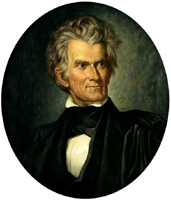
John C. Calhoun by Arthur Schmalz Conrad
by Arthur E. Schmalz Conrad
Oil on canvas, 1958
Sight (oval) measurement
Height: 22.63 inches
(57.5 cm)
Width: 19.5 inches (49.5
cm)
Unsigned
Cat. no. 32.00009.000
Biography of John Caldwell Calhoun
When artist Constantino Brumidi designed the walls of the
Senate Reception Room in the mid-19th century, he planned
five decorative plaster panels, each to contain portraits
of "illustrious men." Brumidi never completed the mural decorations
for the room, and the ovals remained blank. In 1955, by resolution
of the U.S. Senate, a committee was created to choose five
outstanding former senators whose likenesses would fill the
ovals. Senator John F. Kennedy of Massachusetts chaired the
committee as it sought counsel from historians, political
scientists, and senators.
From more than 60 nominees, the committee unanimously selected
three 19th-century senators: Henry Clay of Kentucky, Daniel
Webster of Massachusetts, and John C. Calhoun of South Carolina.
It also chose two 20th-century senators, Robert M. La Follette,
Sr., of Wisconsin and Robert A. Taft, Sr., of Ohio. The committee
reported its recommendations to the full Senate in May 1957,
and later that year a commission was established to oversee
the creation of the portraits. A formal unveiling of the completed
works was held on March 12, 1959. Maryland artist Arthur Conrad,
a graduate of the Yale School of Fine Arts, based his painting
of John C. Calhoun on a life portrait by George P.A. Healy
in the collection of the Virginia Museum of Fine Arts in Richmond.
Healy created the portrait as a preparatory study for a larger
and later painting, Webster's Reply to Hayne. In both of Healy's
works, Calhoun is shown seated in the vice president's chair
in the Senate Chamber. It was from this seat that Calhoun
presided in 1830 during the famous Webster-Hayne debate over
the nullification doctrine. Conrad began his portrait of Calhoun
in his studio and completed the work after it was installed
in the Senate Reception Room. He later executed a replica
of the Senate's portrait for the county courthouse in Abbeville,
South Carolina.
John Caldwell Calhoun served as both a U.S. representative and senator
from South Carolina, and as the seventh vice president of the United
States. Calhoun was born near Calhoun Mills, Abbeville District
(now Mount Carmel, McCormick County), South Carolina. After practicing
law, and serving in the state house of representatives from 1808
to 1809, Calhoun was elected to the U.S. House of Representatives
in 1810. There he became one of Speaker Henry Clay's principal lieutenants
and a leader of the warhawks, a group of young congressmen who advocated
war with Great Britain. As chairman of the House Foreign Affairs
Committee, Calhoun introduced the declaration of war against Britain
in June 1812.
He served as secretary of war under President James Monroe from
1817 to 1825, was elected vice president with John Quincy Adams
in 1824, and was reelected vice president on a ticket with Andrew
Jackson in 1828. To further his opposition to high protective tariffs,
Calhoun devised a doctrine of nullification whereby states could
declare federal laws null and void within their borders. When President
Jackson threatened to use military power to enforce a federal law
nullified by South Carolina, Calhoun broke with Jackson. Calhoun
resigned the vice presidency in December 1832 in order to fill a
vacancy in the U.S. Senate.
A powerful advocate for the Southern position, Calhoun supported
the institution of slavery and the right of slaveholders to extend
the practice into the western territories. Calhoun resigned from
the Senate in 1843 planning to run for president, but instead he
served briefly as secretary of state in the cabinet of President
John Tyler. He was reelected to the Senate in 1845 and remained
there until his death in 1850. Calhoun–-along with Daniel Webster
and Henry Clay–-was part of the "Great Triumvirate" of the Senate's
Golden Age.
For Further Information Please Visit This Site: http://www.senate.gov/