- Oil Painting »
- Charles L. McNary
Charles L. McNary
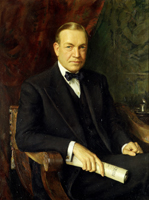
Charles L. McNary
by Henrique Medina (1901 - 1988)
Oil on canvas, 1946
Sight measurement
Height: 39.5 inches (100.3
cm)
Width: 29.5 inches (74.9
cm)
Signature (upper right corner): H. Medina / 1946
Cat. no. 32.00012.000
Biography of Charles Linza McNary
According to Senator Charles McNary's widow, Cornelia Morton
McNary, the governor of Oregon appointed a committee to select
an appropriate portrait of her husband for presentation to
the Senate. Portuguese artist Henrique Medina was chosen to
create an oil on canvas likeness, working from photographs
of the subject. Although the painting was installed in the
Capitol in 1944, it is dated two years later. This discrepancy
was not noted in the period documentation, and the reason
for the later date remains a mystery.
A 1980 Portuguese catalogue of Medina's work featured the
McNary portrait, and specifically commented on the subject's
hands, calling them "fine, sensitive, and cultivated, lending
themselves to a psychological study." [1] Medina's portraits
of Americans distinguished in business, government, education,
and entertainment are held in numerous public and private
collections in this country and throughout Europe.
Charles Linza McNary served as minority leader of the U.S. Senate
between 1933 and 1944. Born in Marion County, Oregon, and educated
in law, McNary was appointed to the Senate to fill vacancies in
1917 and 1918. The following year he won election in his own right.
McNary rose to prominence in 1926 as chairman of the Senate Committee
on Agriculture and Forestry. A strong supporter of farm interests,
he cosponsored the McNary-Haugen bill, which called for shipment
of American surplus farm products abroad to help raise prices. Congress
passed the bill, but President Calvin Coolidge vetoed it. Still,
McNary-Haugen laid the groundwork for later federal farm assistance
programs.
As Republican leader of the Senate, McNary seldom made formal speeches
but excelled as a behind-the-scenes negotiator. He supported much
of the Franklin Roosevelt administration's early legislation. In
turn, McNary won the president's support for construction of the
Bonneville project, the federal dam and electric generating station
on the Columbia River at Bonneville, Oregon. Later, however, McNary
helped unite anti-New Deal forces of both parties in opposition
to the so-called court-packing plan of 1937.
His strategy not only helped to defeat the controversial plan, but
also initiated a new coalition between Republicans and conservative
Democrats that provided the first effective opposition to the New
Deal. McNary became the Republican vice presidential candidate on
the unsuccessful 1940 ticket headed by Wendell Willkie. His political
career ended abruptly when he died following surgery in Florida
in 1944.
For Further Information Please Visit This Site: http://www.senate.gov/