- Oil Painting »
- Daniel Webster by James Henry Wright
Daniel Webster by James Henry Wright
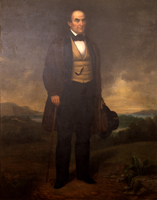
Daniel Webster by James Henry Wright
by James Henry Wright (1813 - 1883)
Oil on canvas, n. d.
Sight measurement
Height: 85.13 inches
(216.2 cm)
Width: 65.25 inches (165.7
cm)
Signature (lower right corner): J H Wright / N.Y.
Cat. no. 32.00017.000
Biography of Daniel Webster
Although little is known about this full-length portrait of
Daniel Webster by James Henry Wright, it was probably based
on one of the many daguerreotypes or engravings of Webster
that were in circulation during the 19th century. It is signed
but undated. On September 21, 1944, Senator Alben W. Barkley
of Kentucky, Senate majority leader and chairman of the Joint
Committee on the Library, introduced a resolution authorizing
acceptance of the Webster portrait as a gift from Lester Martin,
a prominent textile industrialist and philanthropist in New
York City. The resolution was adopted by unanimous consent.
Wright, who maintained a studio at 835 Broadway, was a popular
19th-century New York artist specializing in portraiture,
still lifes, and landscapes. Between 1842 and 1860 he exhibited
in New York City at the National Academy of Design and at
the American Art Union. Other Wright portraits include prominent
mid-19th-century Americans, among them General Winfield Scott
and Matthew Vassar, founder of Vassar College.
One of the nation's greatest orators, Daniel Webster was both a
U.S. senator from Massachusetts and a U.S. representative from Massachusetts
and New Hampshire. Webster was born in Salisbury, New Hampshire,
and gained national prominence as an attorney while serving five
terms in the U.S. House of Representatives. He successfully argued
several notable cases before the Supreme Court of the United States
that helped define the constitutional power of the federal government.
In Trustees of Dartmouth College v. Woodward, the Court declared
in favor of Webster's alma mater, finding private corporation charters
to be contracts and therefore protected from interference by state
legislative action. In McCulloch v. Maryland, the Court upheld the
implied power of Congress to charter a federal bank and rejected
the right of states to tax federal agencies.
Webster also argued the controversial Gibbons v. Ogden case, in
which the Court decided that federal commerce regulations take precedence
over the interstate commerce laws of individual states. After his
election to the U.S. Senate in 1827, Webster established his oratorical
reputation in the famous 1830 debate with Robert Young Hayne of
South Carolina over the issue of states' rights and nullification.
Defending the concept of a strong national government, Webster delivered
on January 26 and 27 his famous reply to Hayne. "We do not impose
geographical limits to our patriotic feeling," he insisted, arguing
that every state had an interest in the development of the nation
and that senators must rise above local and regional narrow-mindedness.
The Constitution is the supreme law of the land, he warned, and
any doctrine that allowed states to override the Constitution would
surely lead to civil war and a land drenched with "fraternal blood."
The motto should not be "Liberty first, and Union afterwards," Webster
concluded, but "Liberty and Union, now and forever, one and inseparable!"
Within weeks of the debate, Webster had become a national hero.
His Senate oration was in greater demand than any other congressional
speech in American history. Webster then served a distinguished
term as secretary of state from 1841 to 1843, negotiating the Webster-Ashburton
Treaty that settled a dispute over the boundary between the U.S.
and Canada. He later returned to the Senate, where he championed
American industry and opposed free trade. If Webster's impassioned
oratory was legendary, it was intensified by his unforgettable physical
presence. Dark in complexion, with penetrating eyes–often likened
to glowing coals–he had an electrifying effect on anyone who saw
him. Nineteenth-century journalist Oliver Dyer wrote: "The God-like
Daniel . . . had broad shoulders, a deep chest, and a large frame.
. . . The head, the face, the whole presence of Webster, was kingly,
majestic, godlike." [1] Increasingly concerned with the sectional
controversy threatening the Union, Webster supported Henry Clay's
Compromise of 1850.
On March 7, 1850, he delivered one of his most important and controversial
Senate addresses. Crowds flocked to the Senate Chamber to hear Webster
plead the Union's cause, asking for conciliation and understanding:
"I wish to speak today not as a Massachusetts man, nor as a Northern
man, but as an American. . . . I speak today for the preservation
of the Union. Hear me for my cause." Webster's endorsement of the
compromise–including its fugitive slave provisions–helped win its
eventual enactment, but doomed the senator's cherished presidential
aspirations. Webster became secretary of state again in 1850, and
he died two years later at his home in Marshfield, Massachusetts.
For Further Information Please Visit This Site: http://www.senate.gov/