- Oil Painting »
- Daniel Webster
Daniel Webster attributed to Richard Francis Nagle
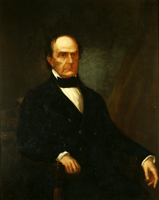
Daniel Webster attributed to Richard Francis Nagle
by Richard Francis Nagle (1835 - 1891 ca.) (attributed)
Oil on canvas, 1849 ca.
Sight measurement
Height: 49.63 inches
(126 cm)
Width: 39.38 inches (100
cm)
Unsigned
Cat. no. 32.00001.000
Biography of Daniel Webster
This oil on canvas portrait of Daniel Webster has been in
the Senate since it was purchased from 19th-century photographer
Mathew Brady in 1881. The picture was acquired together with
canvases of Henry Clay and John C. Calhoun; all three are
believed to have been based on Brady daguerreotypes of the
senators. The paintings were exhibited for many years at Brady's
New York City photographic gallery and later at his studio
in Washington, D.C. Shortly before he sold the three portraits
to the government, Brady was forced to use them as collateral
for a loan. Documents indicate that he later paid the loan
and therefore retained ownership of the paintings. The portraits
of Clay and Calhoun are known to be the work of Henry Darby,
but Webster's portrait is unsigned. It is believed to have
been executed by the painter Richard Francis Nagle.
Nagle was born and trained in Dublin, Ireland. He immigrated
to the United States and is known for portraits of several
New York natives, including likenesses of Generals Winfield
Scott and Ulysses S. Grant. A Nagle descendant claimed that
the artist had been acquainted with Mathew Brady. Indeed,
the New-York Historical Society's collection contains a portrait
of Brady–-albeit not from life–-by Nagle. Brady himself ascribed
the Webster painting to an artist named Nagle in an 1881 signed
statement to the Joint Committee on the Library: "Webster
visited my gallery in June 1849. . . . Five different sittings
were made on this occasion–-Nagle the artist of New York–-made
his study for the painting at the same time." Although it
cannot be verified that Nagle actually lived in New York City,
his portraits connect the artist to that region.
Moreover, the Webster painting bears stylistic resemblances
to many of Nagle's other works. This painting was previously
misattributed to the better known Philadelphia artist John
Neagle, an apparent error made by a clerk in the U.S. Capitol
in the 19th century. No documentary evidence exists to link
the picture to this artist, nor does the painting resemble
other works by John Neagle.
One of the nation's greatest orators, Daniel Webster was both a
U.S. senator from Massachusetts and a U.S. representative from Massachusetts
and New Hampshire. Webster was born in Salisbury, New Hampshire,
and gained national prominence as an attorney while serving five
terms in the U.S. House of Representatives. He successfully argued
several notable cases before the Supreme Court of the United States
that helped define the constitutional power of the federal government.
In Trustees of Dartmouth College v. Woodward, the Court declared
in favor of Webster's alma mater, finding private corporation charters
to be contracts and therefore protected from interference by state
legislative action. In McCulloch v. Maryland, the Court upheld the
implied power of Congress to charter a federal bank and rejected
the right of states to tax federal agencies. Webster also argued
the controversial Gibbons v. Ogden case, in which the Court decided
that federal commerce regulations take precedence over the interstate
commerce laws of individual states.
After his election to the U.S. Senate in 1827, Webster established
his oratorical reputation in the famous 1830 debate with Robert
Young Hayne of South Carolina over the issue of states' rights and
nullification. Defending the concept of a strong national government,
Webster delivered on January 26 and 27 his famous reply to Hayne.
"We do not impose geographical limits to our patriotic feeling,"
he insisted, arguing that every state had an interest in the development
of the nation and that senators must rise above local and regional
narrow-mindedness. The Constitution is the supreme law of the land,
he warned, and any doctrine that allowed states to override the
Constitution would surely lead to civil war and a land drenched
with "fraternal blood." The motto should not be "Liberty first,
and Union afterwards," Webster concluded, but "Liberty and Union,
now and forever, one and inseparable!" Within weeks of the debate,
Webster had become a national hero. His Senate oration was in greater
demand than any other congressional speech in American history.
Webster then served a distinguished term as secretary of state from
1841 to 1843, negotiating the Webster-Ashburton Treaty that settled
a dispute over the boundary between the U.S. and Canada. He later
returned to the Senate, where he championed American industry and
opposed free trade. If Webster's impassioned oratory was legendary,
it was intensified by his unforgettable physical presence. Dark
in complexion, with penetrating eyes–often likened to glowing coals–he
had an electrifying effect on anyone who saw him. Nineteenth-century
journalist Oliver Dyer wrote: "The God-like Daniel . . . had broad
shoulders, a deep chest, and a large frame. . . . The head, the
face, the whole presence of Webster, was kingly, majestic, godlike."
[1] Increasingly concerned with the sectional controversy threatening
the Union, Webster supported Henry Clay's Compromise of 1850. On
March 7, 1850, he delivered one of his most important and controversial
Senate addresses.
Crowds flocked to the Senate Chamber to hear Webster plead the Union's
cause, asking for conciliation and understanding: "I wish to speak
today not as a Massachusetts man, nor as a Northern man, but as
an American. . . . I speak today for the preservation of the Union.
Hear me for my cause." Webster's endorsement of the compromise–including
its fugitive slave provisions–helped win its eventual enactment,
but doomed the senator's cherished presidential aspirations. Webster
became secretary of state again in 1850, and he died two years later
at his home in Marshfield, Massachusetts.
For Further Information Please Visit This Site: http://www.senate.gov/