- Oil Painting »
- Daniel Webster by Adrian Lamb
Daniel Webster by Adrian Lamb
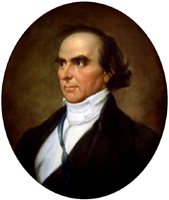
Daniel Webster by Adrian Lamb
by Adrian S. Lamb
Oil on canvas, 1958
Sight (oval) measurement
Height: 22.63 inches
(57.5 cm)
Width: 19.5 inches (49.5
cm)
Unsigned
Cat. no. 32.00006.000
Biography of Daniel Webster
To complete the decorative plaster panels in the Senate Reception
Room of the U.S. Capitol that had been left vacant since the
late 19th century, the Special Committee on the Senate Reception
Room was established in 1955. The Senate charged the committee
with selecting "five outstanding persons from among all persons,
but not a living person, who have served as Members of the
Senate since the formation of the Government of the United
States." Paintings of these individuals would then "be placed
in the five unfilled spaces in the Senate reception room."
[1] The committee consisted of four senior senators and one
freshman senator. Majority Leader Lyndon B. Johnson appointed
the freshman, John F. Kennedy of Massachusetts, to be the
committee's chairman. Kennedy was an ideal choice; his popular
book, Profiles in Courage, skillfully examined the careers
of eight outstanding former senators.
The Kennedy committee spent two years surveying the nation's
leading historians and political scientists, and easily identified
three 19th-century senators: Henry Clay of Kentucky, John
C. Calhoun of South Carolina, and Daniel Webster of Massachusetts.
After much debate, the committee also selected two 20th-century
members: Robert M. La Follette, Sr., of Wisconsin and Robert
A. Taft, Sr., of Ohio. A special Senate commission, composed
of experts in the art field, then selected artists for the
five paintings, including Adrian Lamb of New York for the
portrait of Daniel Webster. The commission determined that
Lamb, like the other artists, should "copy some suitable existing
portrait or other likeness of his particular subject." [2]
Lamb based his painting on an existing oil by George P.A.
Healy in the collection of the Virginia Museum of Fine Arts
in Richmond.
The original portrait, made during a sitting from life in
1848 at Webster's country home in Marshfield, Massachusetts,
had served as a preliminary study for Healy's monumental historical
painting Webster's Reply to Hayne in Faneuil Hall in Boston.
The Virginia museum's Webster likeness was one of four life
studies of the senator executed by Healy during a six-year
period. Adrian Lamb studied at the Art Students League in
New York City and at the Academie Julian in Paris before embarking
on a career as a portraitist. Lamb's works are found in many
collections, including the White House, the Smithsonian Institution,
the U.S. Naval Academy, Harvard University, and the Supreme
Court of the United States. For much of his life, Lamb resided
in Connecticut and maintained a studio in Manhattan.
One of the nation's greatest orators, Daniel Webster was both a
U.S. senator from Massachusetts and a U.S. representative from Massachusetts
and New Hampshire. Webster was born in Salisbury, New Hampshire,
and gained national prominence as an attorney while serving five
terms in the U.S. House of Representatives. He successfully argued
several notable cases before the Supreme Court of the United States
that helped define the constitutional power of the federal government.
In Trustees of Dartmouth College v. Woodward, the Court declared
in favor of Webster's alma mater, finding private corporation charters
to be contracts and therefore protected from interference by state
legislative action. In McCulloch v. Maryland, the Court upheld the
implied power of Congress to charter a federal bank and rejected
the right of states to tax federal agencies. Webster also argued
the controversial Gibbons v. Ogden case, in which the Court decided
that federal commerce regulations take precedence over the interstate
commerce laws of individual states. After his election to the U.S.
Senate in 1827, Webster established his oratorical reputation in
the famous 1830 debate with Robert Young Hayne of South Carolina
over the issue of states' rights and nullification.
Defending the concept of a strong national government, Webster delivered
on January 26 and 27 his famous reply to Hayne. "We do not impose
geographical limits to our patriotic feeling," he insisted, arguing
that every state had an interest in the development of the nation
and that senators must rise above local and regional narrow-mindedness.
The Constitution is the supreme law of the land, he warned, and
any doctrine that allowed states to override the Constitution would
surely lead to civil war and a land drenched with "fraternal blood."
The motto should not be "Liberty first, and Union afterwards," Webster
concluded, but "Liberty and Union, now and forever, one and inseparable!"
Within weeks of the debate, Webster had become a national hero.
His Senate oration was in greater demand than any other congressional
speech in American history. Webster then served a distinguished
term as secretary of state from 1841 to 1843, negotiating the Webster-Ashburton
Treaty that settled a dispute over the boundary between the U.S.
and Canada. He later returned to the Senate, where he championed
American industry and opposed free trade.
If Webster's impassioned oratory was legendary, it was intensified
by his unforgettable physical presence. Dark in complexion, with
penetrating eyes–often likened to glowing coals–he had an electrifying
effect on anyone who saw him. Nineteenth-century journalist Oliver
Dyer wrote: "The God-like Daniel . . . had broad shoulders, a deep
chest, and a large frame. . . . The head, the face, the whole presence
of Webster, was kingly, majestic, godlike." [1] Increasingly concerned
with the sectional controversy threatening the Union, Webster supported
Henry Clay's Compromise of 1850. On March 7, 1850, he delivered
one of his most important and controversial Senate addresses. Crowds
flocked to the Senate Chamber to hear Webster plead the Union's
cause, asking for conciliation and understanding: "I wish to speak
today not as a Massachusetts man, nor as a Northern man, but as
an American. . . . I speak today for the preservation of the Union.
Hear me for my cause." Webster's endorsement of the compromise–including
its fugitive slave provisions–helped win its eventual enactment,
but doomed the senator's cherished presidential aspirations. Webster
became secretary of state again in 1850, and he died two years later
at his home in Marshfield, Massachusetts.
For Further Information Please Visit This Site: http://www.senate.gov/