- Oil Painting »
- Fort Defiance
Fort Defiance
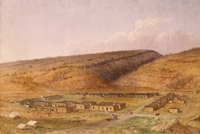
Fort Defiance, New Mexico (now Arizona)
by Seth Eastman (1808 - 1875)
Oil on canvas, 1873
Sight measurement
Height: 60 inches (152.4
cm)
Width: 31.5 inches (80
cm)
Signature (lower left center): S. E. / 187[3]
Cat. no. 33.00011.000
More on the Principal Fortifications of the United States
Of Seth Eastman's fort series, this is the only painting of
an army post in the Southwest. Located at Canyon Bonito about
seven miles north of Window Rock, Arizona, Fort Defiance was
established in 1851 to create a military presence in Navajo
Country. It was built on valuable grazing land that the federal
government then prohibited the Navajo from using. As a result,
the appropriately named fort experienced intense fighting,
culminating in an unsuccessful 1860 attack by the Navajo.
The next year, at the onset of the Civil War, the army abandoned
Fort Defiance. Continued Navajo raids in the area led the
army to send Kit Carson to impose order. His "solution" was
brutal: thousands of starving Navajo were interned in Fort
Sumner, New Mexico, and much of their livestock was destroyed.
The Navajo Treaty of 1868 allowed those interned to return
to a portion of their land, and Fort Defiance was reestablished
as an Indian agency that year. It was during the development
of the fort into an agency that Eastman depicted the site
in his painting, but the evidence of the picture suggests
that he never visited the post. At the base of a butte, a
small, rudimentary block of one-story log and sod buildings
stands on a foreground plain.
A dark gorge divides the butte, and a road emerges from it.
In contrast to the lush, grassy grazing land that typified
Fort Defiance, in the painting everything is barren and inhospitable.
The land is the color of sandalwood, and there is little contrast
in the sky. It is tempting to enumerate the buildings because
they are the focus of the scene. Low barracks fill most of
the small space, but one may discern kitchens, latrines, open
tents, distant cattle, wagons, and about 30 human figures,
including a group of soldiers drilling in the yard. The scene
is prosaic and matter-of-fact, and this is probably why it
seems to embody the true sense of an outpost. Surprisingly,
the feeling is similar to that captured by some 20th-century
films–-the bleak setting of the Western genre, but without
the Native American and army conflict. The decision to omit
all battles from Eastman's series of fort paintings explains
this departure from the bitter reality of life at Fort Defiance.
During the late 18th century and through much of the 19th century,
army forts were constructed throughout the United States to defend
the growing nation from a variety of threats, both perceived and
real. Seventeen of these sites are depicted in a collection painted
especially for the U.S. Capitol by Seth Eastman. Born in 1808 in
Brunswick, Maine, Eastman found expression for his artistic skills
in a military career. After graduating from the U.S. Military Academy
at West Point, where officers-in-training were taught basic drawing
and drafting techniques, Eastman was posted to forts in Wisconsin
and Minnesota before returning to West Point as assistant teacher
of drawing. Eastman also established himself as an accomplished
landscape painter, and between 1836 and 1840, 17 of his oils were
exhibited at the National Academy of Design in New York City.
His election as an honorary member of the academy in 1838 further
enhanced his status as an artist. Transferred to posts in Florida,
Minnesota, and Texas in the 1840s, Eastman became interesed in the
Native Americans of these regions and made numerous sketches of
the people and their customs. This experience prepared him for the
next five yeas in Washington, D.C., where he was assigned to the
commissioner of Indian Affairs and illustrated Henry Rowe Schoolcraft's
important six-volume Historical and Statistical Information Respecting
the History, Condition, and Prospects of the Indian Tribes of the
United States. During this time Eastman also assisted Captain Montgomery
C. Meigs, superintendent of the Capitol extension, in securing the
services of several Native Americans to model for the sculptors
working on the 1850s addition to the building.
In 1867 Eastman returned to the Capitol, this time to paint a series
of nine scenes of Native American life for the House Committee on
Indian Affairs. Eastman's talent and his special knowledge of the
subject certainly qualified him for the commission, which was obtained
for him by House Ways and Means Committee Chairman Robert C. Schenck
of Ohio. Schenck, a former Civil War officer who, like Eastman,
was retired for disability during the war, believed Amerian–-not
European–-artists should recieve the Capitol commissions. In introducing
a resolution urging the hiring of Eastman for the project, Schenck
remarked: Schenck's resolution was approved by the House but tabled
by the Senate. Nevertheless, the retired Eastman was placed–-by
special order of the War Department–-on "active duty" so that he
could be compensated for creating works of art for the Capitol.
He finished the nine paintings in 1869. In 1870 House Military Affairs
Committee Chairman John A. Logan of Illinois proposed that Eastman
produce 17 canvases depicting army forts. It is indicative of the
post-Civil War sentiment in America that Logan specified that Eastman
was not to paint battle scenes; indeed, the mood of these forts
set in landscapes is serene, even nostalgic to some degree.
Never a well man, Eastman was aged and ailing by the time he received
the commission, and it is not known if he visited the forts. He
had been stationed at several of these during his military career,
and as a trained topographical draftsman he probably had plans,
elevations, and even photographs of the forts at his disposal. Eastman
completed the series between 1870 and 1875. Charles E. Fairman,
longtime curator of the Capitol, was slightly dismissive of Eastman's
fort paintings. He thought they were "probably more valuable as
examples of historical accuracy . . . than for purely decorative
purposes." [2] He explained that it was important that knowledge
concerning government fortifications should be easily accessible
and these pictures "contain desired information and also relieve
acceptably what might otherwise be blank spaces upon an uninteresting
wall." [3] Yet without touting Eastman's paintings as masterpieces,
it is still possible to value them as considerably more than repositories
of "desired information." For many years, the fort paintings hung
in the House Military Affairs Committee Room, first in the Capitol
and later in the Cannon House Office Building. During the late 1930s,
they were returned to the Capitol for public display. Of the 17
paintings, eight are located in the Senate, while the others are
displayed on the House side of the Capitol. Eastman was working
on the West Point painting when he died in 1875.
For Further Information Please Visit This Site: http://www.senate.gov/