- Oil Painting »
- The Battle of Fort Moultrie
The Battle of Fort Moultrie
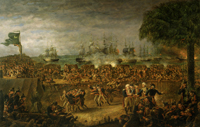
The Battle of Fort Moultrie
by John Blake White (1781 - 1859)
Oil on canvas, 1826
sight measurement
Height: 31.5 inches (80
cm)
Width: 49.5 inches (125.7
cm)
Signature (lower right corner): B. White / 1826
Cat. no. 33.00004.000
History of the Battle of Fort Moultrie
John Blake White's The Battle of Fort Moultrie "portrays in
a spirited manner the famous battle . . . fought and won against
a formidable British fleet . . . just six days prior to the
Declaration of Independence," wrote Octavius White, the artist's
son. Octavius White donated this work to the U.S. Senate in
1901. He gave it to the nation, he said, "that the sons may
know how their fathers fought to secure the precious boon
of liberty."[1] The painting presents a view of the battle
from inside the American fort, with the British fleet firing
at full force in the background. The artist inserted portraits
of William Moultrie and Francis Marion in the right center
foreground. William Jasper is seen defending the fort's flag.
At the center background, along the perimeter wall of the
fort, is the artist's own father, Blake Leay White, who is
thought to have participated in the battle. White based his
portraits on existing likenesses in South Carolina family
collections and on his memory. According to White family tradition,
the artist's father and General Marion, known as the "Swamp
Fox," owned adjoining plantations.
The young artist, it was said, would sit on Marion's knee
during visits. In 1899 Octavius White had presented three
other Revolutionary War paintings by his father to the Senate:
Sergeants Jasper and Newton Rescuing American Prisoners from
the British, General Marion Inviting a British Officer to
Share His Meal, andMrs. Motte Directing Generals Marion and
Lee to Burn Her Mansion to Dislodge the British. Although
White drew inspiration for these works from a biography of
Francis Marion as recounted by Parson Mason Locke Weems, the
artist's source for the Fort Moultrie painting is less clear.
John Blake White was born in Eutaw Springs, South Carolina.
He studied law in Charleston and in 1800 traveled to England
to pursue an art career under the guidance of American artist
Benjamin West.
White returned to the United States three years later and
continued to paint historical subjects, portraits, and miniatures.
His work was exhibited at the Boston Athenaeum, New York's
National Academy of Design, the Apollo Association for the
Promotion of the Fine Arts, and the South Carolina Institute,
where he received a medal for best historical painting. He
was a founder of the South Carolina Academy of Fine Arts.
Although White never gained the artistic recognition he desired,
he painted in his leisure time until about 1840, while practicing
law in Charleston. He also served in the South Carolina state
legislature and wrote several plays.
Just days before the signing of the Declaration of Independence
in 1776, the Battle of Fort Moultrie (then known as Fort Sullivan)
resulted in a significant American victory over the British. Earlier
that year, a crude palmetto-log fort had been built on Sullivan's
Island as a first line of defense for Charleston, South Carolina.
On June 28, the formidable British fleet, under the command of Sir
Peter Parker, attacked. The small American force, led by Colonel
William Moultrie, held its position despite all-day shelling. Moultrie
later described the scene as "one continual blaze and roar; and
clouds of smoke curling over...for hours together."[1] Even though
the British had far superior firepower at their disposal, the spongy
palmetto logs and sand that comprised the American fort absorbed
most of the enemy shells before they could explode.
During the bombardment, the fort's flag—a distinctive silver crescent
on a blue field—was shot down by the British. Ignoring heavy gunfire,
Sergeant William Jasper retrieved the standard and replanted it
on the fort's rampart. At nightfall, the defeated British withdrew.
The American victory ensured the safety of the port of Charleston
and won many people over to the patriot cause. Before this battle,
General George Washington had had little success in the North. The
American triumph at Sullivan's Island showed that the South could
wage a successful campaign.
It stood as a symbolic declaration of independence from the British,
preceding the signing of the actual document by less than a week.
Soon after the victory, the fort was renamed in honor of William
Moultrie, who was later promoted to general. John Rutledge, then
president of the South Carolina assembly, presented Sergeant Jasper
with his dress sword for his bravery and offered him an officer's
commission. Jasper, however, declined the commission as inappropriate
for a man of humble origins. The blue and silver crescent flag that
Jasper replanted during the battle later served as the inspiration
for the South Carolina state flag.
For Further Information Please Visit This Site: http://www.senate.gov/