- Oil Painting »
- Fort Scammel and Fort Gorges
Fort Scammel and Fort Gorges
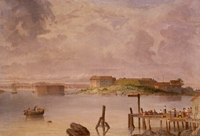
Fort Scammel and Fort Gorges, Maine
by Seth Eastman (1808 - 1875)
Oil on canvas, 1872
Sight measurement
Height: 24.63 inches
(62.5 cm)
Width: 35.63 inches (90.5
cm)
Signature (lower right corner): S. E. / 1872
Cat. no. 33.00015.000
More on the Principal Fortifications of the United States
Following the War of 1812, the Army Corps of Engineers proposed
that a fort be built on Hog Island Ledge, in Casco Bay at
the entrance to the harbor at Portland, Maine. Named for the
colonial proprietor of Maine, Sir Ferdinando Gorges, it was
constructed to support existing forts, including Fort Scammel
built on nearby House Island in 1808. Congress, however, did
not fund construction of Fort Gorges until 1857. The walls
of the fort were begun the next year, and when the Civil War
broke out in 1861, work quickly advanced. It was completed
in 1865 as the war ended, a granite reminder of what might
have been. A modernization plan was begun in 1869, but funding
was cut off in 1876, with the third level of the fort still
unfinished.
Seth Eastman painted his canvas during this final phase. Eastman
gave Fort Scammel and Fort Gorges equal emphasis in his sweeping
view. On the distant waters of the bay, the viewer glimpses
the activity of sailboats and a steamboat, as well as construction
cranes behind both forts. This painting is unusually complex
among the works in the series, in both design elements and
narrative implications. For example, the large pier at the
lower right, its pilings, and the rock and piling at the center
are strongly drawn and tightly composed. The pier is animated
by 11 figures, standing or seated, who have gathered there.
Eastman conveys the specifics of place with attention to the
dress and posture of the figures and the structure and age
of the pier. The lounging atmosphere, the casual note of the
ladder leaning against the small shed at the right, and the
motionless boat with inactive occupants at the left all suggest
a backwater where time stands still. Again, Eastman seems
to compare the foreground idleness with the idleness of the
forts and with dreams of battles never fought. The mood is
greatly enhanced by the large sky, with a variety of cloud
formations tranquilly painted in pale gray tints.
During the late 18th century and through much of the 19th century,
army forts were constructed throughout the United States to defend
the growing nation from a variety of threats, both perceived and
real. Seventeen of these sites are depicted in a collection painted
especially for the U.S. Capitol by Seth Eastman. Born in 1808 in
Brunswick, Maine, Eastman found expression for his artistic skills
in a military career. After graduating from the U.S. Military Academy
at West Point, where officers-in-training were taught basic drawing
and drafting techniques, Eastman was posted to forts in Wisconsin
and Minnesota before returning to West Point as assistant teacher
of drawing. Eastman also established himself as an accomplished
landscape painter, and between 1836 and 1840, 17 of his oils were
exhibited at the National Academy of Design in New York City. His
election as an honorary member of the academy in 1838 further enhanced
his status as an artist. Transferred to posts in Florida, Minnesota,
and Texas in the 1840s, Eastman became interesed in the Native Americans
of these regions and made numerous sketches of the people and their
customs.
This experience prepared him for the next five yeas in Washington,
D.C., where he was assigned to the commissioner of Indian Affairs
and illustrated Henry Rowe Schoolcraft's important six-volume Historical
and Statistical Information Respecting the History, Condition, and
Prospects of the Indian Tribes of the United States. During this
time Eastman also assisted Captain Montgomery C. Meigs, superintendent
of the Capitol extension, in securing the services of several Native
Americans to model for the sculptors working on the 1850s addition
to the building. In 1867 Eastman returned to the Capitol, this time
to paint a series of nine scenes of Native American life for the
House Committee on Indian Affairs. Eastman's talent and his special
knowledge of the subject certainly qualified him for the commission,
which was obtained for him by House Ways and Means Committee Chairman
Robert C. Schenck of Ohio. Schenck, a former Civil War officer who,
like Eastman, was retired for disability during the war, believed
Amerian–-not European–-artists should recieve the Capitol commissions.
In introducing a resolution urging the hiring of Eastman for the
project, Schenck remarked: Schenck's resolution was approved by
the House but tabled by the Senate. Nevertheless, the retired Eastman
was placed–-by special order of the War Department–-on "active duty"
so that he could be compensated for creating works of art for the
Capitol. He finished the nine paintings in 1869. In 1870 House Military
Affairs Committee Chairman John A.
Logan of Illinois proposed that Eastman produce 17 canvases depicting
army forts. It is indicative of the post-Civil War sentiment in
America that Logan specified that Eastman was not to paint battle
scenes; indeed, the mood of these forts set in landscapes is serene,
even nostalgic to some degree. Never a well man, Eastman was aged
and ailing by the time he received the commission, and it is not
known if he visited the forts. He had been stationed at several
of these during his military career, and as a trained topographical
draftsman he probably had plans, elevations, and even photographs
of the forts at his disposal. Eastman completed the series between
1870 and 1875. Charles E. Fairman, longtime curator of the Capitol,
was slightly dismissive of Eastman's fort paintings. He thought
they were "probably more valuable as examples of historical accuracy
. . . than for purely decorative purposes." [2]
He explained that it was important that knowledge concerning government
fortifications should be easily accessible and these pictures "contain
desired information and also relieve acceptably what might otherwise
be blank spaces upon an uninteresting wall." [3] Yet without touting
Eastman's paintings as masterpieces, it is still possible to value
them as considerably more than repositories of "desired information."
For many years, the fort paintings hung in the House Military Affairs
Committee Room, first in the Capitol and later in the Cannon House
Office Building. During the late 1930s, they were returned to the
Capitol for public display. Of the 17 paintings, eight are located
in the Senate, while the others are displayed on the House side
of the Capitol. Eastman was working on the West Point painting when
he died in 1875.
For Further Information Please Visit This Site: http://www.senate.gov/