- Oil Painting »
- George Washington by Gilbert Stuart
George Washington by Gilbert Stuart
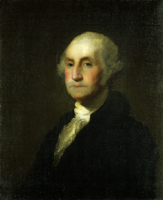
George Washington by Gilbert Stuart
by Gilbert Stuart (1755 - 1828)
Oil on canvas, 1796 ca. - 1798
Sight measurement
Height: 28.63 inches
(72.7 cm)
Width: 23.63 inches (60
cm)
Unsigned
Cat. no. 31.00003.000
Biography of George Washington
Gilbert Stuart's second and most important life portrait of
George Washington was an oil painting executed in 1796. Best
known as the image on the one-dollar bill, it is considered
the most famous painting of the first president. The portrait,
which shows the left side of Washington's face, was painted
when the president was 64 years old. It came to be known as
the "Athenaeum portrait" because it was acquired by the Boston
Athenaeum just after the artist's death. The Athenaeum owned
it for 150 years. (In this and other references, "Athenaeum
head," "Athenaeum Washington," or "Athenaeum portrait" refer
to this original life portrait, today owned jointly by the
Smithsonian Institution's National Portrait Gallery in Washington,
D.C., and the Museum of Fine Arts in Boston.
Two replica portraits owned by the Senate–-one shown here
and the one known as the "Pennington Portrait"–-and all other
replicas of the same type are referred to as "Athenaeum type"
or "copy or replica of the Athenaeum portrait.") The Athenaeum
Washington was executed through the intervention of Anne Bingham,
wife of Senator William Bingham of Pennsylvania, probably
in preparation for a half-length portrait commissioned by
her husband. Bingham subsequently changed his mind and ordered
a full-length portrait instead–-and a copy for William Petty,
Lord Shelburne, the first Marquis of Lansdowne. These full-length
"Lansdowne-type" portraits of Washington are now, respectively,
in the Pennsylvania Academy of the Fine Arts in Philadelphia,
and the National Portrait Gallery. The Athenaeum head was
left unfinished by Stuart, who retained it during his lifetime.
He kept the portrait from life in order to make numerous replicas
(some 70 in the bust-length format) from it.
There were, of course, alterations in the replicas, some subtle
and some more pronounced. These might have been due to haste
or to other factors not now known. The costume, hardly indicated
in the original life portrait, was continually reinvented
by the artist. This particular replica of the Athenaeum portrait,
sometimes referred to as the "Chesnut portrait," was purchased
from the artist by Colonel John Chesnut of South Carolina
in the late 1790s. Chesnut had served with South Carolina
regiments in the American Revolution and was a member of the
South Carolina state convention to ratify the federal Constitution.
Thomas Chesnut, heir to the original owner, sold the portrait
in 1870 to art collector W.W. Corcoran, founder of the Corcoran
Gallery of Art in Washington, D.C. The Joint Committee on
the Library, in turn, purchased the painting from Corcoran
for the United States Capitol in 1876, the nation's centennial
year.
The Chesnut portrait is of both documentary and aesthetic
interest. Washington sat for Stuart for the Athenaeum head
in April 1796, and he departed Philadelphia at the end of
his second term in March 1797. It has been assumed that General
Chesnut acquired this replica about the time he sat for Stuart
for his own portrait, while on a visit to Philadelphia in
1797-98. Some writers maintain that the president appears
older here than in the Athenaeum head. To account for this
difference, it has been claimed that the political attacks
endured by Washington during his second term aged him, and
that Stuart was able to incorporate the change because Washington
agreed to another sitting.
However, this hypothesis conveniently ignores the very short
time thus assumed between the two sittings. It is highly unlikely
that the president would have granted a sitting to Stuart
in the waning months of his administration, and Stuart did
not subsequently visit him at Mt. Vernon. The difference in
appearance may more aptly be called weariness than aging,
and it would have been a relatively easy matter for Stuart
to alter the portrait to suggest this change, without requiring
a sitting. There is a perceptible softening of the modeling,
for instance. The president's eyes seem more shadowed and
his face less fleshy–-in short, somewhat gaunt–-despite the
apple-red cheeks that Stuart often favored for his sitters.
For this replica, Stuart embellished the costume with a fluidly
improvised shirtfront, like liquid lace. Gilbert Stuart is
undoubtedly one of America's greatest portrait painters. Having
trained in Europe, he returned to this country with the prospect
of greater financial gain. Known for his elegant and fashionable
portrait style, he painted war heroes, socialites, and prominent
families. But it was George Washington whom he most sought
to paint, and it was his Washington portraits that provided
him with the greatest financial reward. Other national figures
that Stuart recorded on canvas included John Adams, Thomas
Jefferson, and James Madison.
George Washington, first president of the United States, earned
the epithet Father of His Country for his great leadership, both
in the fight for independence and in unifying the new nation under
a central government. Washington was born in Westmoreland County,
Virginia, and worked as a surveyor in his youth. In 1752 he inherited
a family estate, Mount Vernon, upon the death of a half brother,
Lawrence. Washington's military career began in 1753, when he accepted
an appointment to carry a warning to French forces who had pushed
into British territory in the Ohio valley.
In subsequent military assignments, Washington distinguished himself
against the French, first while aiding General Edward Braddock and
later as commander-in-chief of all Virginia militia. In 1758 Washington
returned to civilian life as a gentleman-farmer at Mount Vernon
and soon took a seat in the Virginia house of burgesses. As a planter,
Washington had firsthand knowledge of the economic restrictions
being imposed by Britain, and as a Virginia legislator, he supported
political efforts to curtail British control of the colonies. Washington
was selected to serve as a delegate to the first and second Continental
Congresses, and in June 1775 he was chosen to command the American
forces.
He successfully led the Continental army through eight difficult
years of war for independence. In 1783, after the Revolution, Washington
resigned his military commission to Congress at Annapolis, Maryland.
Recognizing the need for a strong central government, he served
as president of the federal convention charged with drafting the
Constitution. Reluctantly, he accepted the will of his colleagues
to become president of the new nation, and he was inaugurated in
New York City on April 30, 1789. Contending with the ideological
struggles within the government, and with hostilities between France
and Great Britain, Washington greatly feared the growth of political
parties and the dangers of foreign involvement. These issues impelled
him to serve a second term as president.
His attempts to solve foreign relations issues during his second
term resulted in Jay's Treaty (1794), a vain attempt to regulate
trade and settle boundary disputes with Great Britain, and the Pinckney
Treaty (1795), which successfully settled such issues with Spain.
Washington also acted vigorously to enforce federal authority by
quashing the Whiskey Rebellion, during which liquor producers in
western Pennsylvania threatened the new republic by rebelling against
an unpopular excise tax on whiskey.
Washington's 1796 Farewell Address to the nation emphasized the
need for a unified federal government and warned against party faction
and foreign influence. Although often subjected to harsh criticism
by his contemporaries, Washington succeeded in giving the new government
dignity. He saw a federal financial system firmly established through
the efforts of Alexander Hamilton, and he set valuable precedents
in the conduct of the executive office. Washington retired to Mount
Vernon, where he died on December 14, 1799.
For Further Information Please Visit This Site: http://www.senate.gov/