- Oil Painting »
- George Washington by Gilbert Stuart
George Washington by Gilbert Stuart
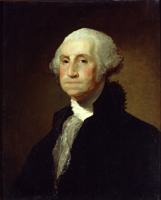
George Washington by Gilbert Stuart
by Gilbert Stuart (1755 - 1828)
Oil on canvas, 1796 ca. - 1805
Sight measurement
Height: 28.75 inches
(73 cm)
Width: 23.63 inches (60
cm)
Unsigned
Cat. no. 31.00004.000
Biography of George Washington
This skillful replica by Gilbert Stuart of his Athenaeum portrait
of George Washington is commonly known as the "Pennington
portrait." It takes its name from its first owner, Edward
Pennington, a Philadelphian who was a founder of the Pennsylvania
Academy of the Fine Arts. It may be assumed that Pennington
acquired the Washington portrait around the time Stuart was
in Bordentown, New Jersey, where Stuart left his family while
he was in Washington, D.C., and Baltimore, and where at least
some of Pennington's family lived. (Stuart painted a portrait
of Edward Pennington around 1802, and the painting is now
located at the Atwater Kent Museum in Philadelphia.) The Washington
portrait owned by Pennington later came into the possession
of Mrs. Cicero W. Harris of Washington, D.C., who in 1886
sold it to the Joint Committee on the Library for placement
in the U.S. Capitol.
In this replica, Stuart paints Washington's face and hair
more boldly and summarily than he does in some other replicas.
For example, he emulates the fleshy bridge of Washington's
nose with a creamy swirl of paint. The flesh coloring is nicely
balanced, without the strong crimson cheeks Stuart often favors,
although his characteristic use of red in the shadows of the
upper eyelids is apparent. The modeling of the mouth seems
somewhat hesitant, as if the artist were trying to modify
the puffy distortion caused by the president's notorious false
teeth. The paint is applied with particular fluency in the
lacy shirtfront. There is a compelling directness about this
image that is explained, in part, by the secure placement
of the head on the canvas. When compared with the Senate's
other Athenaeum-type head–-the Chesnut portrait–-the Pennington
head is more securely positioned on the canvas. It is firmly
in the upper half of the field and more strongly centered.
Washington's left eye lies precisely at the horizontal midpoint.
Were the head to rotate to a frontal position, it would be
more symmetrically placed than would the head in the Chesnut
portrait. The white neckcloth–-the strongest, brightest tone
in the painting–-provides a solid pedestal for the head. Equally
admirable in this version is Stuart's control of the lighting
and, therefore, the coherence of forms in space. For instance,
a nicely gauged, faint highlight defines the back of the high
coat collar where it meets the striking bow of black ribbon.
The ribbon secures the black silk bag that holds the long
hair at the back. (This fashion appeared around 1770; alternatively,
the back hair was dressed in a queue, or pigtail.) The hair
ribbon is unusually elaborate, larger than that used on a
pigtail (which would not be visible from the front), and its
serrated contour is visually confusing to the modern viewer.
But Stuart's subtle highlighting helps differentiate the shapes
within that large black area.
In addition, the gradation of light across the background
suggests space and gives the head still more force while enhancing
the effective, persuasive design of the torso, whose proper
right contour has a melodic descent. The painting has hung
in various locations in the Capitol since it was acquired,
and it was also displayed at the Corcoran Gallery of Art in
Washington, D.C., in 1932 as part of an exhibition celebrating
the bicentennial of Washington's birth.
George Washington, first president of the United States, earned
the epithet Father of His Country for his great leadership, both
in the fight for independence and in unifying the new nation under
a central government. Washington was born in Westmoreland County,
Virginia, and worked as a surveyor in his youth. In 1752 he inherited
a family estate, Mount Vernon, upon the death of a half brother,
Lawrence. Washington's military career began in 1753, when he accepted
an appointment to carry a warning to French forces who had pushed
into British territory in the Ohio valley.
In subsequent military assignments, Washington distinguished himself
against the French, first while aiding General Edward Braddock and
later as commander-in-chief of all Virginia militia. In 1758 Washington
returned to civilian life as a gentleman-farmer at Mount Vernon
and soon took a seat in the Virginia house of burgesses. As a planter,
Washington had firsthand knowledge of the economic restrictions
being imposed by Britain, and as a Virginia legislator, he supported
political efforts to curtail British control of the colonies. Washington
was selected to serve as a delegate to the first and second Continental
Congresses, and in June 1775 he was chosen to command the American
forces.
He successfully led the Continental army through eight difficult
years of war for independence. In 1783, after the Revolution, Washington
resigned his military commission to Congress at Annapolis, Maryland.
Recognizing the need for a strong central government, he served
as president of the federal convention charged with drafting the
Constitution. Reluctantly, he accepted the will of his colleagues
to become president of the new nation, and he was inaugurated in
New York City on April 30, 1789. Contending with the ideological
struggles within the government, and with hostilities between France
and Great Britain, Washington greatly feared the growth of political
parties and the dangers of foreign involvement.
These issues impelled him to serve a second term as president. His
attempts to solve foreign relations issues during his second term
resulted in Jay's Treaty (1794), a vain attempt to regulate trade
and settle boundary disputes with Great Britain, and the Pinckney
Treaty (1795), which successfully settled such issues with Spain.
Washington also acted vigorously to enforce federal authority by
quashing the Whiskey Rebellion, during which liquor producers in
western Pennsylvania threatened the new republic by rebelling against
an unpopular excise tax on whiskey. Washington's 1796 Farewell Address
to the nation emphasized the need for a unified federal government
and warned against party faction and foreign influence.
Although often subjected to harsh criticism by his contemporaries,
Washington succeeded in giving the new government dignity. He saw
a federal financial system firmly established through the efforts
of Alexander Hamilton, and he set valuable precedents in the conduct
of the executive office. Washington retired to Mount Vernon, where
he died on December 14, 1799.
For Further Information Please Visit This Site: http://www.senate.gov/