- Oil Painting »
- George Washington by William Dunlap
George Washington by William Dunlap
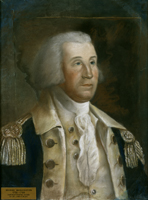
George Washington by William Dunlap
by William Dunlap (1766 - 1839)
Pastel on paper, 1783 ca.
Sight measurement
Height: 25.5 inches (64.8
cm)
Width: 19.5 inches (49.5
cm)
Unsigned
Cat. no. 31.00015.000
Biography of George Washington
William Dunlap's pastel portrait of George Washington is remarkable
as the earliest-known painting by a man better known for his
invaluable publication History of the Rise and Progress of
the Arts of Design in the United States (1834), the first
attempt to chronicle the art of this country. The painting
survived (despite damage by fire while it resided in San Francisco)
for more than 150 years in the possession of the Van Horne
family, its authenticity affirmed by Dunlap himself. In 1838,
near the end of his life, Dunlap wrote a statement confirming
his authorship of the Senate's Washington pastel, briefly
describing the circumstances of the sitting. Equally conclusive,
and more compelling, is the story of the portrait's origin
included in his autobiography–-already published in his Rise
and Progress. Having received meager training in art from
the American painter William Williams, Dunlap embarked on
his youthful career in 1782 by executing portraits in "crayons"
(pastels) of his father, other relatives, and friends.
In the autumn of 1783, he visited Rocky Hill, New Jersey,
home of John Van Horne. General Washington's temporary headquarters
was nearby while Congress was convening at Princeton College,
and Washington was a frequent visitor to the Van Horne home,
so Dunlap "was of course introduced to him." [1] The young
artist had made pastel portraits of Mr. and Mrs. Van Horne,
and Washington praised them ("doubtless the mere wish to encourage
youth," according to Dunlap). As a result, Dunlap recalled,
John Van Horne "requested him to sit to me and he complied.
This was a triumphant moment for a boy of seventeen...but
it was one of anxiety, fear and trembling." [2] Although family
tradition maintains that Dunlap's portrait of Washington was
executed at the Van Horne estate, Dunlap's very specific,
detailed, and charming reminiscence differs: It would be pleasant
to report that the portrait was as fine as the praise bestowed
on the young man's work, but, in fact, it is labored and awkward.
The Continental army uniform (despite evident effort) is mostly
unconvincing, from the odd abstraction of the ruffled shirtfront
to the epaulets that look more like strands from an old mop.
Still, to his credit, Dunlap manages to render Washington's
prominent and idiosyncratic nose with success, and the eye
sockets are smoothly modeled.
One spatial problem–-the viewer's uncertainty that a neck
lies behind the neck cloth–-may well be due to the fact that
Dunlap had lost the sight of his right eye in a childhood
accident. This loss "prevented all further regular schooling,"
and Dunlap also believed that "either from nature or the above
accident, I did not possess a painter's eye for colour; but
I was now devoted to painting as a profession, and I did not
suspect any deficiency." [4] It is much more likely that his
spatial perception, rather than his color perception, was
altered. But there is no need to belabor the shortcomings
of a teenager's portrait of the most famous man of his day.
Dunlap was his own severest critic. Early in his artistic
career, Dunlap had gone to London to study with American neoclassical
painter Benjamin West. On his return, he established himself
as a portrait and miniature painter, while also working as
a theatrical manager.
He later painted large allegorical and religious pictures,
similar to those of Benjamin West. Looking back from old age
to his early painting career, Dunlap wrote, "I now intend
to show the causes that, at the age of twenty-three, and after
a long residence in London, left me ignorant of anatomy, perspective,
drawing, and colouring, and returned me home a most incapable
painter." [5] In addition to painting, Dunlap spent time as
a militia paymaster, was one of the founders of the National
Academy of Design in New York City, and was involved in civic
and cultural affairs throughout his lifetime.
He remarked at one time, "The good artist who is not a good
man, is a traitor to the arts, and an enemy to society." [6]
In 1926 Augustus Van Horne Ellis wrote to Charles Fairman,
curator for the architect of the Capitol, about the youthful
Dunlap's "crayon portrait" of General George Washington from
life, which had been handed down through his family. The two
men corresponded over the next 11 years, discussing the possible
gift of the portrait to the U.S. government. Not until after
Ellis's death, however, was the painting accepted by the Joint
Committee on the Library as a gift to the "Senate branch of
the Capitol" from Anne Middleton Ellis in memory of her husband.
George Washington, first president of the United States, earned
the epithet Father of His Country for his great leadership, both
in the fight for independence and in unifying the new nation under
a central government. Washington was born in Westmoreland County,
Virginia, and worked as a surveyor in his youth. In 1752 he inherited
a family estate, Mount Vernon, upon the death of a half brother,
Lawrence. Washington's military career began in 1753, when he accepted
an appointment to carry a warning to French forces who had pushed
into British territory in the Ohio valley. In subsequent military
assignments, Washington distinguished himself against the French,
first while aiding General Edward Braddock and later as commander-in-chief
of all Virginia militia. In 1758 Washington returned to civilian
life as a gentleman-farmer at Mount Vernon and soon took a seat
in the Virginia house of burgesses.
As a planter, Washington had firsthand knowledge of the economic
restrictions being imposed by Britain, and as a Virginia legislator,
he supported political efforts to curtail British control of the
colonies. Washington was selected to serve as a delegate to the
first and second Continental Congresses, and in June 1775 he was
chosen to command the American forces. He successfully led the Continental
army through eight difficult years of war for independence. In 1783,
after the Revolution, Washington resigned his military commission
to Congress at Annapolis, Maryland. Recognizing the need for a strong
central government, he served as president of the federal convention
charged with drafting the Constitution. Reluctantly, he accepted
the will of his colleagues to become president of the new nation,
and he was inaugurated in New York City on April 30, 1789. Contending
with the ideological struggles within the government, and with hostilities
between France and Great Britain, Washington greatly feared the
growth of political parties and the dangers of foreign involvement.
These issues impelled him to serve a second term as president.
His attempts to solve foreign relations issues during his second
term resulted in Jay's Treaty (1794), a vain attempt to regulate
trade and settle boundary disputes with Great Britain, and the Pinckney
Treaty (1795), which successfully settled such issues with Spain.
Washington also acted vigorously to enforce federal authority by
quashing the Whiskey Rebellion, during which liquor producers in
western Pennsylvania threatened the new republic by rebelling against
an unpopular excise tax on whiskey. Washington's 1796 Farewell Address
to the nation emphasized the need for a unified federal government
and warned against party faction and foreign influence. Although
often subjected to harsh criticism by his contemporaries, Washington
succeeded in giving the new government dignity. He saw a federal
financial system firmly established through the efforts of Alexander
Hamilton, and he set valuable precedents in the conduct of the executive
office. Washington retired to Mount Vernon, where he died on December
14, 1799.
For Further Information Please Visit This Site: http://www.senate.gov/