- Oil Painting »
- George Washington at Princeton
George Washington at Princeton
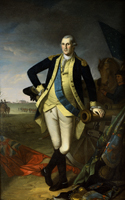
George Washington at Princeton
by Charles Willson Peale (1741 - 1827)
Oil on canvas, 1779
Sight measurement
Height: 91.63 inches
(232.7 cm)
Width: 58.38 inches (148.3
cm)
Signature (lower left corner): C: W: Peale pinxt: / Philadelphia
1779
Cat. no. 31.00002.000
History of the Battle of Princeton
Charles Willson Peale painted George Washington more times
from life than any other artist. In 1772 Peale visited Washington's
home, Mount Vernon, to portray the hero as a colonel of the
Virginia regiment, the only pre-Revolutionary likeness of
him. In 1795 Peale and other members of his family painted
the president for the last time during his second term. All
told, Peale had seven opportunities to paint the great man
at different times in his career, and he replicated many of
the paintings. None was as popular as the enduring image of
Washington after the Battle of Princeton, which was commissioned
by the Supreme Executive Council of Pennsylvania for its council
chamber in Independence Hall in Philadelphia. The original,
now owned by the Pennsylvania Academy of the Fine Arts, was
completed in early 1779, when Washington sat for Peale in
Philadelphia. An immediate success, it precipitated a great
demand for replicas.
Of the estimated 18 replicas, the superlative Senate picture
is the earliest recorded one that Peale made, although there
was a contemporary published notice that five replicas had
been ordered as early as February 1779. The Senate picture
was purchased from the artist by the French Ambassador Conrad-Alexandre
Gerard, probably on behalf of Louis XVI, and paid for with
a bill of exchange on July 15, 1779. The ambassador, who sat
for Peale for his own portrait in September, took the painting
of Washington home to France shortly thereafter and presented
it to the king. This scenario is confirmed in a letter from
Peale, dated October 15, 1779, to Edmund Jenings in Brussels.
Peale sent Jenings a miniature portrait of Washington, with
the remark that "The Likeness is something different from
that which his Excellency Sieur Gerard Carries for the King."
[1] Henry Tuckerman, in his 1867 Book of the Artists, wrote
that "the misfortunes of the royal family occasioned its [the
portrait's] sale, and it became the property of Count de Menou,
who brought it again to this country." [2]
It is not clear when that occurred, but the count is reported
to have sold the painting in October 1841 to Charles B. Calvert
of Prince George's County, Maryland, for $200. Calvert, in
turn, deposited it with The National Institution for the Promotion
of Science (incorporated in 1842 as simply the National Institute).
In 1858 the art objects owned by the institute were transferred
to the Smithsonian Institution. Explorer-naturalist Titian
Ramsey Peale II, a son of the artist, petitioned the Smithsonian
Institution's Board of Regents in 1870, claiming ownership
of the painting on behalf of his father's heirs. The claim
was rejected because of insufficient evidence, but in February
1882 the U.S. Senate passed a resolution instructing the Joint
Committee on the Library to "inquire into the expediency of
purchasing the picture . . . now alleged to be the property
of Titian R. Peale." [3] On April 10, 1882, the committee
paid $5,000 to Titian Peale to acquire the portrait. The portrait,
with its specific reference to a battle, was a complicated
undertaking.
Of course, Peale invented the composition. Washington, wearing
a blue and buff uniform with the blue sash of the commander-in-chief,
leans lightly on the barrel of a captured cannon. Two Hessian
flags captured at Trenton are beside him and at his feet.
A British ensign lies on the ground to the left. Behind him,
an officer holds his commander's horse, while above them flies
the blue battle flag with a circle of 13 stars. A second horse
is glimpsed at the right. On a shadowed rise in the left middle
distance, beside a barren, wintry tree, are two mounted soldiers
with rifles. One of them gestures toward a procession of 16
red-coated prisoners under guard farther back. Beyond is a
group of six or seven buildings, including Nassau Hall, the
principal building of the College of New Jersey (now Princeton
University). The hall was included for its significance in
the battle–-the engagement actually ended within its walls.
It was a landscape Peale knew well. The artist had served
in the Continental army for three years, commanding a company
of Philadelphia militia. He saw action at the Battles of Trenton,
Princeton, and Germantown. At Princeton, he found himself
in the front line at the battle's climax, with Washington
in command. It is rare, indeed, for a painter of military
history to have participated in the engagement being depicted.
Peale wrote in his diary that they "stood the Fire without
regarding [the] Balls which whistled their thousand different
notes around our heads, and what is very astonishing did little
or no harm." [4] Peale visited both Trenton and Princeton
to observe and sketch the landscape in preparation for the
painting, and he obviously had vivid memories of the Battle
at Princeton. To modern viewers, Washington's cross-legged
pose–-a complex play of angles and curves around the central
vertical axis of the upper left leg, torso, and head–-may
seem awkward. The curves of the coat's edges, sash, and left
arm are played against the abrupt angles of Washington's right
elbow, his left knee, and his heels. Peale effectively repeats
the shapes of the elbow and the brim of the hat, held inverted
in Washington's right hand. Asymmetries animate the portrait:
Washington leans slightly, which pulls his head just to the
right of center, with the angle balanced by the inward angle
of the battle flag.
Peale likely modeled this pose after one of Thomas Gainsborough's
masterpieces, Augustus Hervey, 3rd Earl of Bristol, located
at the National Trust's Ickworth House in England. Although
the stance (derived from ancient Roman sculptural sources)
was quite prevalent in English portraiture of the period,
this Gainsborough painting of a naval captain offers the closest
parallel to Peale's portrait, including a captured battle
flag at the feet. With two years of study and practice in
London (1767-69) behind him, Peale had a solid knowledge of
contemporary English portraiture. In the 1768 Society of Artists
Exhibition in London, in which Peale himself exhibited, he
had seen the Gainsborough painting. The most significant difference
between the two subjects arises from Peale's literal directness:
Where Gainsborough's Hervey is positioned on a diagonal within
the picture space and looks away from the viewer, Peale's
Washington is nearly frontal and looks directly at the viewer
with a candid, affable expression. This is, in fact, a defining
characteristic of Peale's portraiture. Avoiding any classical
symbolism (he had earlier pictured William Pitt in a Roman
toga), Peale produced a realistic, accurate portrait of the
general. At six foot two, Washington stood a full head above
the average soldier in his army.
He had narrow shoulders, wide hips, long arms and legs, and
very large hands and feet. His head was small in relation
to the length of his body Although Peale's likeness of Washington
did not match the ideal canon of proportions espoused by the
art academies, it was nonetheless accurate. Peale knew the
general better than any other artist did, and his artistic
abilities are not in doubt. In addition, the full-length portraits
of Washington by John Trumbull and Jean-Antoine Houdon second
the evidence of Peale's likeness. Only Gilbert Stuart's several
full-length portraits seem closer to ideal proportions, and
their greater public fame has given them an authority they
do not deserve. Stuart idealized his sitters more than Peale
did, and when he was painting the general's body, he used
a visitor to his studio as a surrogate model. Apart from the
face, Stuart's Washington fails as an accurate record of the
hero's physical appearance.
In Peale's painting, Washington is strongly silhouetted against
a pinkish-blue sky, with the horizon line at the mid-level
of the canvas. It is dawn, the hour when the battle commenced.
It might, at the same time, be the symbolic dawn of eventual
success in the War for Independence. Optimism is embodied
in the general's glowing face: Confident and self-possessed,
this is the definitive image of George Washington at the apogee
of his vigorous manhood and military career. The popular success
of George Washington at Princeton led to orders for as many
replicas as Peale could produce. In August 1779 the artist
wrote: "I have on hand a number of portraits of Gen. Washington.
One the ambassador had for the Court of France, another is
done for the Spanish Court, one other has been sent to the
island of Cuba, and sundry others, which I have on hand are
for private gentlemen." [5] Versions vary in size and composition–-with
the background and the treatment of the figure of Washington
altered by Peale.
Changes included replacing the soldiers and horses with a
bleak winter landscape, updating the general's insignia according
to the most recently issued orders, and giving greater prominence
to the colonial flag. Other full-length versions by Charles
Willson Peale are found at Princeton University in New Jersey,
the Metropolitan Museum of Art in New York, Colonial Williamsburg,
and the Virginia Museum of Fine Arts.
The Battle of Princeton, New Jersey, fought on January 3, 1777,
followed George Washington's legendary victory at nearby Trenton.
There, Washington braved floating ice to cross the Delaware River
in the early morning hours of December 26, 1776, and defeated a
brigade of Hessian mercenaries. Afterwards, he returned to his Pennsylvania
camp. On December 30, Washington recrossed the river and took position
outside Trenton, on the south bank of Assunpink Creek. Under orders
to destroy the American army and avenge the defeat at Trenton, the
British commander, Lord Cornwallis, marched to meet Washington,
leaving three regiments behind at Princeton as a rear guard.
American detachments harassed and delayed the British advance, and
it was not until dusk on January 2 that the British army arrived
in front of the American position. After fitful skirmishing, Cornwallis
decided to encamp for the night, intending to attack the Americans
the next day. Expecting this strategy, Washington broke camp, leaving
a few men to keep the fires lit and the appearance that all was
unchanged. Taking an unguarded back road, he and his men slipped
past Cornwallis's army during the night and, at dawn on January
3, encountered British reinforcements hurrying from Princeton to
join Cornwallis. Unprepared for the sudden meeting, the American
advance guard was routed. However, Washington soon arrived on the
field, rallied his troops, and led a charge that put the British
to flight and opened the way to Princeton.
After a short engagement in the town itself, the remainder of the
British garrison surrendered. By the time Cornwallis arrived on
the outskirts of the town with his main force, Washington had slipped
away. The Battles of Trenton and Princeton are considered among
Washington's greatest victories. The success of those 10 crucial
days bolstered American morale and renewed confidence in the Revolutionary
War effort.
For Further Information Please Visit This Site: http://www.senate.gov/