- Oil Painting »
- Arthur Gorman
Arthur P. Gorman
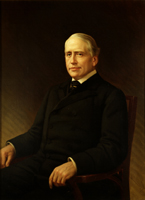
Arthur P. Gorman
by Louis P. Dieterich (1841/1842 ca. - 1922)
Oil on canvas, 1911
Sight measurement
Height: 45.5 inches (115.6
cm)
Width: 33.38 inches (84.8
cm)
Signature (lower right corner): L. Dieterich / 1911
Cat. no. 32.00019.000
Biography of Arthur Pue Gorman
Louis Dieterich's portrait of Arthur Pue Gorman was presented
to the Senate by Gorman's family in 1943. At a dedication
ceremony in the Capitol that year, the oil painting was unveiled
by Arthur Gorman Lambert, the senator's grandson. Senator
George Radcliffe of Maryland introduced the resolution directing
the acceptance of the portrait and acted as master of ceremonies,
while Majority Leader Alben Barkley accepted the portrait
for the Joint Committee on the Library. Born in Germany,
Dieterich moved with his family to Baltimore as a youth. Although
he was primarily self-taught, he also studied at the Maryland
Institute of Art, where he later became an instructor. Dieterich
maintained a studio in Baltimore for many years. Before executing
the Senate's portrait, the artist completed two earlier paintings
of Gorman that are in the collections of the Maryland State
Archives and the Maryland Historical Society.
Identified with the U.S. Senate through much of his life, Arthur
Pue Gorman began his career as a page in the House of Representatives
in 1852 and later transferred to the same post in the Senate through
the influence of Stephen A. Douglas. He went on to hold a series
of staff positions in the Senate, eventually becoming Senate postmaster.
In 1866, because of his support of the unpopular President Andrew
Johnson, he lost the postmastership. Gorman, born in Woodstock,
Maryland, returned to his home state, where he held appointive and
elective positions, becoming a leader in the state Democratic Party
and a member of the state legislature. Elected to the U.S. Senate
from Maryland in 1880, Gorman chaired the Democratic National Committee
in 1884 and directed Grover Cleveland's successful presidential
campaign.
Gorman later opposed the president's tariff policy, provoking Cleveland's
enmity. During his long Senate career, Gorman was considered an
outstanding party leader; he served as chairman of the Democratic
caucus in both the majority and minority in an era before formal
floor leaders. Although his 1898 reelection bid was unsuccessful,
Gorman returned to the Senate in 1903. He again chaired his party's
caucus, a position he held until his death in 1906.
For Further Information Please Visit This Site: http://www.senate.gov/