- Oil Painting »
- Hattie Caraway
Hattie Caraway
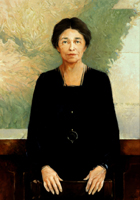
Hattie Caraway
by John Oliver Buckley (1941 - Present) Oil on canvas, 1996
Sight measurement
Height: 39.5 inches (100.3
cm)
Width: 29.75 inches (75.6
cm)
Signature (lower right corner): J O Buckley
Cat. no. 32.00028.000
Biography of Hattie Ophelia Wyatt Caraway
In August 1993, Senators Dale Bumpers and David Pryor of Arkansas
proposed to the Senate Commission on Art that a portrait of
Hattie Caraway be considered for the Senate wing of the Capitol.
The request met the acquisition policy guidelines established
by the commission in 1976: Caraway had been out of office
for more than 21 years, and historians who studied the senator's
political career agreed that she would be an appropriate subject
for the Senate's collection of commemorative portraits. The
Hattie Caraway Portrait Committee was subsequently formed
in Arkansas, with the wives of Senators Bumpers and Pryor
serving as honorary cochairs.
This committee selected four Arkansas artists for consideration.
The Senate Commission on Art–-on the recommendation of a three-member
advisory panel comprising museum curators from the Smithsonian
Institution and the White House, and a professional artist–-chose
Arkansas painter John O. Buckley for the commission. The Caraway
portrait was initially unveiled at ceremonies in April 1996
at the Arkansas Statehouse in Little Rock and also in Jonesboro,
Arkansas. The portrait was then unveiled at the U.S. Capitol
on June 24, 1996. Buckley, who is from Little Rock, holds
a master's degree in fine arts from the University of Texas
at Austin and has taught studio courses in painting and drawing
at the University of Arkansas.
Hattie Ophelia Wyatt Caraway, born in Bakerville, Tennessee, was
the first woman elected to a full term in the U.S. Senate. Following
her marriage to Thaddeus H. Caraway in 1902, she settled in Jonesboro,
Arkansas, where her husband became a U.S. congressman and later
a U.S. senator. Upon her husband's death in 1931, Hattie Caraway
was appointed to take his place in the Senate as a Democrat from
Arkansas. She subsequently won a January 1932 special election to
finish her late husband's term.
She ran for reelection to a full term later that same year, with
Louisiana Senator Huey Long stumping Arkansas on her behalf. The
1932 campaign was one of the most colorful in modern American history.
Long's effort worked: Caraway became the first woman ever to be
elected to a six-year term in the U.S. Senate. Caraway initially
spoke so infrequently in the Senate that she became known as "Silent
Hattie." As she grew more comfortable in her role, Caraway emerged
as a fiercely partisan supporter of New Deal legislation, seconding
the nomination of President Franklin Roosevelt for reelection at
the 1936 Democratic National Convention. She was the first woman
to preside over the Senate–-on May 9, 1932–-and the first to chair
a Senate committee (Committee on Enrolled Bills, 1933-44).
Although she was reelected in 1938, she failed to win renomination
in 1944. After leaving the Senate, Caraway served on the United
States Employees' Compensation Commission from 1945 to 1946 and
on the Employees' Compensation Appeals Board from 1946 until her
death in 1950 in Virginia.
For Further Information Please Visit This Site: http://www.senate.gov/