- Oil Painting »
- Henry Clay by Allyn Cox
Henry Clay by Allyn Cox
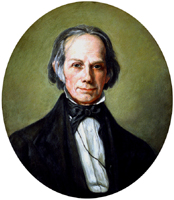
Henry Clay by Allyn Cox
by Allyn Cox
Oil on canvas, 1958
Sight (oval) measurement
Height: 22.63 inches
(57.5 cm)
Width: 19.5 inches (49.5
cm)
Unsigned
Cat. no. 32.00007.000
Biography of Henry Clay
In 1955 the Senate decided to honor five of its most significant
former members by commissioning their portraits for permanent
display in the Reception Room adjacent to the Senate Chamber.
The portraits were placed in oval medallions on the walls
originally planned for likenesses of "illustrious men" but
left vacant when Constantino Brumidi painted the room in the
mid-19th century. A committee chaired by Senator John F. Kennedy
of Massachusetts was formed to choose the five outstanding
members; Henry Clay, Daniel Webster of Massachusetts, and
John C. Calhoun of South Carolina were easily selected. The
committee had difficulty determining the final two subjects,
but eventually agreed on Robert M. La Follette, Sr., of Wisconsin
and Robert A. Taft, Sr., of Ohio, both Republicans. Following
the selection of the five senators, a special Senate commission
was charged with choosing American artists to paint the five
portraits.
The commission was composed of the architect of the Capitol,
the director of the National Gallery of Art, and the chairman
of the Commission on Fine Arts. In 1953 New York muralist
Allyn Cox had been hired to complete the frieze in the Capitol
Rotunda left unfinished since the 1880s; now he was chosen
to supervise portraits for the Reception Room, assuring visual
harmony. Cox would also paint the Henry Clay portrait. The
commission originally intended the portraits to be painted
directly onto plaster in the Senate Reception Room. However,
Cox persuaded them that the portraits should be executed on
canvas, which could then be attached to the wall. The commission
also altered its plan to have the portraits painted simultaneously
in the Reception Room. Instead, the artists worked on the
portraits in their own studios, gathering at the Capitol to
put the finishing touches on the paintings after installation.
The commission recommended that Cox base his likeness of Clay
on George P.A. Healy's portrait, now owned by the Virginia
Museum of Fine Arts in Richmond. The Healy portrait was created
during a two-month sitting in 1845 at Clay's Kentucky home,
Ashland. Healy found that Clay, with his quickly changing
moods and expressions, was a challenge to capture on canvas.
Clay was delighted with the result, however, stating: "You
are a capital portrait painter, Mr. Healy. You are the first
to do justice to my mouth, and it is well pleased to express
its gratitude." [1] Born in New York City in 1896, Allyn Cox
apprenticed to his father, the artist Kenyon Cox, working
on murals for the Wisconsin State Capitol. He later studied
at the National Academy of Design and the Art Students League
in New York City, and at the American Academy in Rome. In
1952 Cox began an association with the U.S. Capitol that was
to last throughout his life.
In addition to his work in the Capitol Rotunda and his portrait
of Henry Clay, Cox was commissioned to depict the first landing
on the Moon for a panel in the Senate's Brumidi Corridors,
and his many murals of historic scenes and personalities decorate
the ceiling and walls of the first floor corridors on the
House side of the Capitol. Dubbed "the American Michelangelo,"
Cox died of a stroke in 1982, just five days after attending
a ceremony held in his honor on September 21 in National Statuary
Hall at the Capitol.
The "Great Compromiser," Henry Clay, a native of Virginia, moved
to Kentucky at the age of 20 and settled in Lexington. There he
practiced law with great success, aided by his sharp wit and nimble
mind. In 1806, after a stint in the Kentucky legislature, he was
elected to fill the unexpired term of a U.S. senator who had resigned.
Clay took the seat, although he was four months younger than the
constitutional age requirement of 30. In 1807 he again was elected
to the Kentucky legislature, where he eventually served as Speaker.
Clay spent most of the years from 1811 to 1825 in the U.S. House
of Representatives, where he was elected Speaker his first day in
office. Almost immediately Clay made a name for himself as one of
the warhawks, the young politicians who fueled anti-British sentiment
and helped bring about the War of 1812. In 1814, he served as one
of the commissioners negotiating the Treaty of Ghent, which ended
the war. During his years in the House, the well-respected Clay
was elected Speaker six times. It was during his time in the U.S.
House that Clay urged that the United States become the center of
an "American System," joined by all of South America, to wean the
country away from dependence on the European economy and politics.
He dedicated much of his career to a high protective tariff on imported
goods, a strong national bank, and to extensive improvements in
the nation's infrastructure. In 1825, after an unsuccessful campaign
for the presidency, Clay was appointed secretary of state under
John Quincy Adams. He served in that position until 1829, and was
subsequently elected to the U.S. Senate. From 1831 to 1842, and
again from 1849 to 1852, Clay distinguished himself as one of the
Senate's most effective and influential members. Clay earned the
sobriquet "Great Compromiser" by crafting three major legislative
compromises over the course of 30 years. Each time, he pulled the
United States from the brink of civil war. In 1820 and 1821, he
used his role as Speaker of the House to broker the Missouri Compromise,
a series of brilliant resolutions he introduced to defuse the pitched
battle as to whether Missouri would be admitted to the Union as
a slave state or free state. Although he owned slaves himself, Clay
anguished about slavery, which he called a "great evil." He believed
slavery would become economically obsolete as a growing population
reduced the cost of legitimate labor.
Under Clay's compromise, Missouri was admitted as a slave state
and Maine as a free state. In 1833 Clay's skill again was tested
when South Carolina passed an ordinance that nullified a federally
instituted protective tariff. Although President Andrew Jackson
urged Congress to modify the tariff, he threatened to use federal
troops against South Carolina if the state refused to collect it.
Despite a long-standing enmity toward Jackson and with a deep commitment
to high tariffs, Clay ended the crisis by placating both sides.
He introduced a resolution that upheld the tariff but promised its
repeal in seven years. The argument over slavery flared once again
in 1850 when Congress considered how to organize the vast territory
ceded by Mexico after the Mexican War. As in 1820, Clay saw the
issue as maintaining the balance of power in Congress. His personal
appeal to Daniel Webster enlisted the support of that great statesman
for Clay's series of resolutions, and civil war was again averted.
Clay died in 1852. Despite his brilliant service to the country
and three separate campaigns, he never attained his greatest ambition–-the
presidency. A man of immense political abilities and extraordinary
charm, Clay won widespread admiration, even among his adversaries.
John C. Calhoun, whom he had bested in the Compromise of 1850, once
declared, "I don't like Clay. . . . I wouldn't speak to him, but,
by God! I love him."
For Further Information Please Visit This Site: http://www.senate.gov/