- Oil Painting »
- Henry Clay
Henry Clay
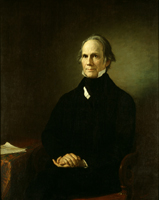
Henry Clay by Henry Darby
by Henry F. Darby (1829 - 1897)
Oil on canvas, 1858 ca.
Sight measurement
Height: 49.25 inches
(125.1 cm)
Width: 39.75 inches (101
cm)
Signature (lower right corner): H. F. DARBY
Cat. no. 32.00002.000
Biography of Henry Clay
Henry F. Darby, who painted this portrait of Henry Clay, shared
a studio with noted painter Samuel Colman in the late 1850s.
What little is known of Darby comes from Colman's recollections
and Darby's own writings, now in the collection of the Oneida
Historical Society in New York. These include correspondence
and a journal he wrote at age 65 for his daughter. Born in
North Adams, Massachusetts, Darby was self-taught, except
for brief instruction from itinerant painters. According to
one account, he was painting in oils by 1842, when he was
13. Evidence of his precocity is found in a fascinating painting,
The Reverend John Atwood and His Family, in the Museum of
Fine Arts in Boston.
Here Darby's style is that of a determined New England limner,
and the group portrait, fully signed and dated 1845, is a
remarkable achievement, compelling in its realism. In 1847
Darby became a teacher at the South Carolina Female College
in Barhamville. He soon returned north, where he lived in
New York City and Brooklyn from 1853 to 1860 and displayed
portraits at the annual exhibitions of the National Academy
of Design. In 1859-60 he showed paintings of John C. Calhoun
and Clay. Darby, who was briefly married, divided his time
between Brooklyn, his wife's family home in Brownsville, New
York, and Washington, D.C. He was a deeply religious man,
and the death of his wife in 1858 impelled him to abandon
portrait painting. After placing his young daughter in the
care of his wife's family, Darby studied for the ministry,
and in 1865 he became deacon of St. John's Episcopal Church
in Whitesboro, New York. In 1869 he sailed to England, where
he briefly served the Anglican Church.
He had returned to America by 1873, when records place him
at Saint Saviour's Church in Bridgeport, Connecticut. Later
he moved to New York City. Darby continued to paint–-mainly
religious themes–-and he exhibited works as late as 1882 at
the Utica Art Association. Few of these later works survive.
Age brought failing health, and the artist took up residence
with his daughter in Fishkill, New York, where he died in
1897. The portrait of Henry Clay is simply conceived: a three-quarter-length
figure is seated in a wooden armchair. Darby has placed the
chair at a slight angle to the picture plane, next to the
corner of a covered table. On the table's surface lie some
sheets of paper and a quill pen. Darby has positioned Clay's
head to the right of center, and he has devoted most of his
attention to the precise and convincing modeling of it. Brightly
lit, the superb face radiates intellect and self-control.
The hands are at rest but are expressive and pictorially pleasing.
The large canvas tends to dissipate the focus; Clay's suit
and the background are monotonous (doubtless they have darkened
over time). The stark presentation of figure against dark
ground hints at the pictorial source of the portrait: a daguerreotype
of Clay.
The painting was apparently created by projecting a collodion
plate onto a sensitized canvas, then painting over the image
in oil. The effect is precisely that of an enlarged photograph.
Mathew Brady, who owned this painting and Darby's portrait
of John Calhoun, and from whom the Senate acquired both, wrote
in 1881 that he had made a photographic portrait of Clay in
1850 and that "Darby made his study at the same time for the
oil painting." But several scholars believe instead that a
photograph, attributed either to Brady or to the Boston firm
of Southworth and Hawes, was Darby's main source. Brady did
not say that Darby painted his portrait of Clay in 1850, only
"his study." The actual portrait was probably painted nearer
to the date of its 1860 exhibition at the National Academy
of Design in New York City. Likewise, Darby's portrait of
Calhoun (which Brady associated with an 1849 photographic
session) is signed and dated 1858, and the Clay may date from
the same time. Darby's portraits of Clay and Calhoun are among
the earliest to owe their composition (and, to some extent,
their appearance) to assistance from photography.
The invention of photography had a notable effect on portrait
painting. Initially, at least, it reinforced the descriptive
naturalism that was already a common trait of 19th-century
portraiture. And for patrons of lesser means, it became a
replacement for painted portraits, including miniatures. While
some painters feared the competition from photography, many
artists agreed with the opinion of painter-photographer-inventor
Samuel F.B. Morse, who observed in 1839: "Art is to be wonderfully
enriched by this discovery. How narrow and foolish the idea
which some express that it will be the ruin of art. . . .
Nature, in the results of Daguerre's process, . . .shows that
the minutest detail disturbs not the general repose."
The "Great Compromiser," Henry Clay, a native of Virginia, moved
to Kentucky at the age of 20 and settled in Lexington. There he
practiced law with great success, aided by his sharp wit and nimble
mind. In 1806, after a stint in the Kentucky legislature, he was
elected to fill the unexpired term of a U.S. senator who had resigned.
Clay took the seat, although he was four months younger than the
constitutional age requirement of 30. In 1807 he again was elected
to the Kentucky legislature, where he eventually served as Speaker.
Clay spent most of the years from 1811 to 1825 in the U.S. House
of Representatives, where he was elected Speaker his first day in
office. Almost immediately Clay made a name for himself as one of
the warhawks, the young politicians who fueled anti-British sentiment
and helped bring about the War of 1812. In 1814, he served as one
of the commissioners negotiating the Treaty of Ghent, which ended
the war.
During his years in the House, the well-respected Clay was elected
Speaker six times. It was during his time in the U.S. House that
Clay urged that the United States become the center of an "American
System," joined by all of South America, to wean the country away
from dependence on the European economy and politics. He dedicated
much of his career to a high protective tariff on imported goods,
a strong national bank, and to extensive improvements in the nation's
infrastructure. In 1825, after an unsuccessful campaign for the
presidency, Clay was appointed secretary of state under John Quincy
Adams. He served in that position until 1829, and was subsequently
elected to the U.S. Senate. From 1831 to 1842, and again from 1849
to 1852, Clay distinguished himself as one of the Senate's most
effective and influential members. Clay earned the sobriquet "Great
Compromiser" by crafting three major legislative compromises over
the course of 30 years. Each time, he pulled the United States from
the brink of civil war. In 1820 and 1821, he used his role as Speaker
of the House to broker the Missouri Compromise, a series of brilliant
resolutions he introduced to defuse the pitched battle as to whether
Missouri would be admitted to the Union as a slave state or free
state.
Although he owned slaves himself, Clay anguished about slavery,
which he called a "great evil." He believed slavery would become
economically obsolete as a growing population reduced the cost of
legitimate labor. Under Clay's compromise, Missouri was admitted
as a slave state and Maine as a free state. In 1833 Clay's skill
again was tested when South Carolina passed an ordinance that nullified
a federally instituted protective tariff. Although President Andrew
Jackson urged Congress to modify the tariff, he threatened to use
federal troops against South Carolina if the state refused to collect
it. Despite a long-standing enmity toward Jackson and with a deep
commitment to high tariffs, Clay ended the crisis by placating both
sides. He introduced a resolution that upheld the tariff but promised
its repeal in seven years.
The argument over slavery flared once again in 1850 when Congress
considered how to organize the vast territory ceded by Mexico after
the Mexican War. As in 1820, Clay saw the issue as maintaining the
balance of power in Congress. His personal appeal to Daniel Webster
enlisted the support of that great statesman for Clay's series of
resolutions, and civil war was again averted. Clay died in 1852.
Despite his brilliant service to the country and three separate
campaigns, he never attained his greatest ambition–-the presidency.
A man of immense political abilities and extraordinary charm, Clay
won widespread admiration, even among his adversaries. John C. Calhoun,
whom he had bested in the Compromise of 1850, once declared, "I
don't like Clay. . . . I wouldn't speak to him, but, by God! I love
him."
For Further Information Please Visit This Site: http://www.senate.gov/