- Oil Painting »
- Henry Laurens
Henry Laurens
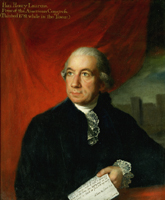
Henry Laurens
by Lemuel Francis Abbott (1760 ca. - 1802)
Oil on canvas, 1781 or 1784
Sight measurement
Height: 31 inches (78.7
cm)
Width: 25 inches (63.5
cm)
Inscription (upper left corner): Hon: Henry Laurens, / Pres:
of the American Congress. / (Painted 1781. while in the Tower.)
Cat. no. 31.00010.000
Biography of Henry Laurens
This painting of Henry Laurens depicts the statesman as he
appeared in 1781 during his 15-month political imprisonment
in the Tower of London. Inscribed in the upper left corner
of the canvas are the words "Hon: Henry Laurens,/ Pres: of
the American Congrefs. / (Painted 1781. while in the Tower.)"
Officials at the Corcoran Gallery of Art in Washington, D.C.,
brought the painting to the attention of the Joint Committee
on the Library in 1886. The committee acted to acquire the
picture from London dealer Henry Stevens & Son after the Corcoran's
founder, William W. Corcoran, declined to do so. In this accomplished
portrait, Laurens looks away from the viewer and slightly
upward while holding a letter in his left hand, his arm resting
on a table.
A dark red curtain hangs diagonally behind him, opening to
a view over his left shoulder of a castellated building that
represents the Tower, where the portrait was painted. The
face is convincingly and expressively modeled. The dignified,
sober expression befits Laurens's political importance and
his unpromising situation, both of which are concisely stated
in the inscription in the upper left corner of the painting.
The letter that Laurens holds in his hand contains these words:
I have acted the part of a fait[hful] / subject. I now go
resolved still to labour for / peace at the same time determined
in the / last event to stand or fall with my country./ I have
the honour to be / Henry Laurens When acquired for the U.S.
Capitol in 1886, the portrait was ascribed to John Singleton
Copley.
That attribution, however, is not compatible with the style
of the small, full-length portrait of Laurens–-now in the
Smithsonian Institution's National Portrait Gallery in Washington,
D.C.–-that Copley painted just after Laurens was released
from prison in 1782. Instead of Copley's crispness of contour
and strong impasto, the Senate's portrait is distinguished
by softness, both in the free contours of the coat and in
the broad, malleable planes of the face. It is known from
Laurens's correspondence that he was painted while in the
Tower by one "Mr. Abbot [sic]" of 20 New Cavandish Street,
Portland Place–-certainly Lemuel Francis Abbott. During this
period, Abbott was indeed active in London, where he specialized
in half-length portraits of diplomats and military figures.
His style, as known especially from numerous paintings in
the National Portrait Gallery in London, is so close to the
style of the Senate painting that there is little doubt that
Abbott painted it. A complication is introduced by another
letter that Laurens wrote in June 1784 before his return to
America. He tells his daughter that his agent, Mr. Bridgen,
"intends to get a Copy of the painting by Mr. Abbot [sic]"
and "has called upon me for the fragment of the Letter which
was or is intended to be [emphasis added] marked on the picture.
Enclosed you will find it as accurately penned as memory serves
at the distance of near ten years." It may be inferred that
Abbott had not added the text of the letter to his 1781 Tower
portrait–-or that Laurens was not sure that he had.
Since he then asks his daughter to take a copy of this inscription
to Abbott "and speak to him respecting the copy of the picture,"
he surely means to commission Abbott to paint a replica of
his 1781 life portrait. There is no reason to doubt that the
Senate portrait is an original by Abbott–-either his 1781
painting from life or his 1784 replica. The enclosure that
Laurens sent to his daughter has not survived. Obviously,
the quotation recalled after a decade referred to something
Laurens had written before the American Revolution, something
of which he remained proud. Like many colonials, particularly
in South Carolina, where the British ties remained strongest,
Laurens was torn by conflicting loyalties. In the same passage
in his letter to his daughter, Laurens makes that clear: In
the headlong, unpunctuated rush of Laurens's words of 1784,
something of the passionate conflict that the statesman felt
as revolution approached is reborn. That he chose his pre-Revolutionary
words as his motto on a portrait representing his darkest
hour is both a patriot's creed and a reminder of how the choice
between king and conscience had been thrust upon him.
Henry Laurens, a patriot and statesman, was born in Charleston,
South Carolina. A leading merchant in that city, Laurens later owned
and managed several plantations. He got his start in politics when
he was elected to the commons house of assembly in 1757. Laurens
lived in London beginning in 1771, but returned to South Carolina
three years later. There he was elected a delegate to the first
provincial congress and later became its president.
He served in the Continental Congress from 1777 to 1780 and succeeded
John Hancock as its president. In August 1780, en route abroad to
negotiate a treaty and loan with Holland, Laurens was captured off
Newfoundland by the British and was confined for 15 months in the
Tower of London. Because he was held on suspicion of high treason,
Laurens could not be exchanged as a military prisoner of war. During
his difficult confinement, he wrote two pro-British petitions, although
he maintained his commitment to the patriot cause.
These submissive petitions were sharply criticized in America. Laurens
was eventually released–-in exchange for Lord Cornwallis–-and he
joined Benjamin Franklin, John Adams, and John Jay in Paris to negotiate
the articles of peace with Great Britain. Laurens then acted as
unofficial minister to England until 1784, when he returned to New
York and reported to Congress. In declining health and suffering
heavy wartime property losses, Laurens retired to his home on South
Carolina's Cooper River until his death in 1792.
For Further Information Please Visit This Site: http://www.senate.gov/