- Oil Painting »
- Isaac Bassett
Isaac Bassett
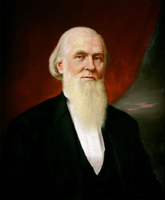
Isaac Bassett
by Freeman Thorp (1844 - 1922)
Oil on canvas, 1876
Sight measurement
Height: 29.5 inches (74.9
cm)
Width: 24.5 inches (62.2
cm)
Signature (lower right): Thorp / 1876
Cat. no. 31.00017.000
Biography of Isaac Bassett
In 1876 members of the Senate commissioned artist Freeman
Thorp to paint a portrait of Isaac Bassett as a "testimonial
of their personal regard and of their high appreciation of
the intelligence, the promptness, the accuracy, and the conscientious
fidelity" that had exemplified Bassett's 45 years of service
up to that point. In his memoirs Bassett himself describes
the simple, touching presentation ceremony: Exactly how Thorp
completed the painting without arousing Bassett's suspicions
is unknown.
Perhaps the artist worked from a photograph, because there
is an existing image of Bassett that resembles the painting.
In 1991 Elizabeth Rummel Crosby, Isaac Bassett's great-granddaughter,
donated the painting of Bassett to the U.S. Senate. Thorp
was born in Ohio and worked extensively in photography before
turning to oil painting. Over the years he executed a number
of portraits of prominent individuals, including the Senate's
painting of Abraham Lincoln. Seven of Thorp's works are also
located in the House wing of the Capitol.
Isaac Bassett began his Senate career in December 1831, at the age
of 12, when he was appointed by Daniel Webster to serve as the institution's
second page. Bassett's father, Simeon Bassett, was a Senate messenger
at the time, and young Isaac frequently accompanied him to the U.S.
Capitol. Isaac Bassett later recalled, "on one of these visits .
. . Daniel Webster called me to him and took me up in his lap and
. . . said to me: 'My little man, would you like to be made a page?'"
Promoted to messenger in 1838 and to assistant doorkeeper in 1861,
Bassett worked in the Senate Chamber, attending nearly every legislative
session until his death in 1895.
He was deeply esteemed by senators and fellow employees alike for
his discreet, faithful, and dedicated service. "I have tried to
do my duties and act honestly," he wrote, and for this the Senate
honored him with gifts and testimonials on several occasions. By
the 1880s the elderly Bassett, with his long gray beard and dignified
bearing, had become an icon of the gentlemanly, statesmanlike qualities
that represented the Senate at its best. He was a willing subject
for newspaper reporters, cartoonists, and photographers, always
ready to regale anyone who would listen with stories of the Senate
in "olden times" and of the great men who had served then. Bassett's
most abiding legacy to the Senate is the manuscript he left behind
at his death, which provides an unparalleled view into the institution
during the 19th century.
Hoping to have a memoir of his Senate experiences published posthumously
"to give the public the benefit of these years of observation among
public men," he made copious notes and compiled a rich array of
newspaper clippings describing the Senate's people, traditions,
and procedures. The book was never published. However, the manuscript
survived, faithfully preserved by Bassett's descendants and eventually
donated to the U.S. Senate.
For Further Information Please Visit This Site: http://www.senate.gov/