- Oil Painting »
- James Hamilton Lewis
James Hamilton Lewis
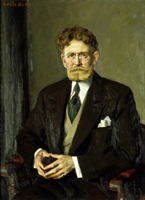
J. Hamilton Lewis
by Louis Betts (1873 - 1961)
Oil on canvas, n. d.
Sight measurement
Height: 39.5 inches (100.3
cm)
Width: 28.88 inches (73.3
cm)
Signature (upper left corner): Louis Betts
Cat. no. 32.00015.000
Biography of James Hamilton Lewis
Without ceremony, this oil likeness of J. Hamilton Lewis by
Louis Betts was hung in the U.S. Capitol in November 1940.
A formal unveiling was postponed until the Illinois delegation
could be present following the fall congressional recess.
The portrait was presented by the senator's widow to the Joint
Committee on the Library shortly before it was exhibited in
the Senate wing of the Capitol. The precise date and circumstances
of the picture's execution are not known. Betts was, however,
a skilled copyist who spent a number of years studying and
working in the mode of Europeans Frans Hals and Diego Velasquez.
Betts may have copied a photograph of Lewis that was published
in 1940, the year after his death, for the portrait closely
resembles this image.
A successful portraitist, Betts grew up in Chicago and was
especially identified with that city, though he achieved recognition
in capitals both here and abroad. As a student, he trained
under his father, Edwin D. Betts, and later with William Merritt
Chase at the Pennsylvania Academy of the Fine Arts in Philadelphia.
A 1923 art journal observed: "[Betts] employs no accessories
to heighten his effects. . . . He has only one aim . . . to
set down on canvas for all time what manner of man or woman
or child is before him as he or she is revealed to him by
the spirit which gleams from the eyes." [1] Betts maintained
a studio in New York City. He was awarded a bronze medal at
the St. Louis Exposition in 1904 and numerous other prizes
in succeeding years. The National Academy of Design presented
him with a gold medal in 1931.
James Hamilton Lewis served the state of Washington in the U.S.
House of Representatives, and the state of Illinois in the U.S.
Senate. Born in Danville, Virginia, Lewis spent most of his youth
in Georgia. In 1885, however, he left the South and moved to Seattle,
where he established a law practice and became active in territorial
politics. After Washington's admission to the Union, Lewis was elected
in 1896 to the U.S. House of Representatives. There he argued for
recognition of Cuba's independence and for the establishment of
the Mount Rainier area as a national park. After losing both his
congressional seat in 1898 and a subsequent bid for the U.S. Senate,
Lewis moved to Chicago, where he once again became active in Democratic
politics.
In 1913 he was elected to the U.S. Senate from Illinois, the last
senator chosen by that state legislature before the ratification
of the 17th Amendment, which provided for the direct election of
senators. Lewis became the first Democratic whip of the Senate.
He was defeated at the end of his first term but won another term
in 1930 and was reelected in 1936. Lewis resumed his role as party
whip during his second and third terms. He was an authority on the
U.S. Constitution and on foreign affairs, and a skillful legislative
tactician. Lewis stood out among his contemporaries for his eloquent
oratory and courtly manner. He died in office; his funeral service
was held in the Senate Chamber.
For Further Information Please Visit This Site: http://www.senate.gov/