- Oil Painting »
- Sergeants Jasper and Newton
Sergeants Jasper and Newton
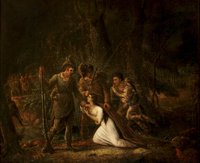
Sergeants Jasper and Newton Rescuing American Prisoners from the British
by John Blake White (1781 - 1859)
Oil on canvas, n. d.
Sight measurement
Height: 24.13 inches
(61.3 cm)
Width: 29 inches (73.7
cm)
Unsigned
Cat. no. 33.00003.000
History of the Prisoner Rescue by Sergeants Jasper and Newton
John Blake White, in his painting Sergeants Jasper and Newton
Rescuing American Prisoners from the British, depicts the
daring rescue recorded by Parson Mason Locke Weems. Though
stylized and rife with patriotic romanticism, White's account
is less fanciful than most artistic renderings of the event,
including a Currier and Ives engraving titled The Rescue.
In White's depiction, the two sergeants stand with the muskets
they have snatched from the British. The young father who
inspired the rescue holds his son, while his wife sinks to
her knees in gratitude. Recounted Weems: "Directing her eyes
to Jasper and Newton . . . she ran and fell on her knees before
them . . . crying out vehemently, 'Dear angels! dear angels!
God bless you! God Almighty bless you for ever!' " [1] The
Senate, by resolution of February 17, 1899, accepted the painting,
Sergeants Jasper and Newton Rescuing American Prisoners from
the British.
Octavius White, son of the artist, presented this work, along
with two other paintings by his father: General Marion Inviting
a British Officer to Share His Meal and Mrs. Motte Directing
Generals Marion and Lee to Burn Her Mansion to Dislodge the
British. Two years later, Octavius White donated a fourth
work by his father, The Battle of Fort Moultrie. This painting
of Sergeants Jasper and Newton, as well as John Blake White's
painting of General Marion and the British officer, were engraved
by John Sartain for popular sale. They were widely distributed
by the Apollo Association for the Promotion of the Fine Arts
in the United States, a subscription organization better known
by its later title, the American Art-Union. For an annual
fee, members would receive engravings of selected works as
well as the opportunity to win originals through raffle drawings.
The association's choice of the White paintings for distribution
gave them a broader, national audience. The same two paintings
also appeared on Confederate banknotes issued in 1861 by South
Carolina, the home state of John Blake White.
About two miles north of Savannah, Georgia, in August 1779, two
patriots dramatically rescued a desperate group of Americans held
prisoner behind British lines. Now legendary, this Revolutionary
War incident was recounted by Parson Mason Locke Weems, who also
popularized the fabricated tale of George Washington and the cherry
tree. Although scholars have not been able to verify Weems's account
of the rescue, it appears to be essentially accurate. The story
involves General Francis Marion and two of his scouts. Known as
the "Swamp Fox," Marion commanded guerrilla operations in South
Carolina throughout the Revolutionary War.
The scouts–-William Jasper, who had previously distinguished himself
at the Battle of Fort Moultrie, and John Newton–-observed a group
of about 10 American prisoners while visiting Jasper's brother,
a loyalist encamped with the British forces. The Americans were
about to be sent downriver for trial at Savannah and probable execution.
Sergeants Jasper and Newton were said to have been particularly
moved by the plight of a young man accompanied by his grief-stricken
wife and child. The two scouts–-who were dressed in civilian attire
and trained to move through the woods undetected to gather information
and intercept British patrols–-hid and followed the party as it
headed to Savannah. Without arms, they waited at a watering hole
in hopes of waylaying the British escort. As the guards rested their
guns, Jasper and Newton overpowered them, took the muskets, and
freed the grateful prisoners.
For Further Information Please Visit This Site: http://www.senate.gov/