- Oil Painting »
- John Adams Dix
John Adams Dix
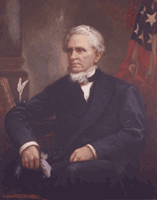
John Adams Dix
by Imogene Robinson Morrell (1818 ca. - 1908)
Oil on canvas, 1883
Sight measurement
Height: 48.75 inches
(123.8 cm)
Width: 38.75 inches (98.4
cm)
Signature (lower left corner): Imogene ROBINSON MORRELL. /
1883
Cat. no. 32.00014.000
Biography of John Adams Dix
Painter Imogene Morrell created her life-size portrait of
John Adams Dix several years after the statesman's death.
While the inspiration for her painting is unknown, it bears
a striking resemblance to Daniel Huntington's 1879 portrait
of Dix (located at the New-York Historical Society). An engraving
by Alexander Hay Ritchie, after the Huntington portrait, appears
in the two-volume book, Memoirs of John Adams Dix, compiled
in 1883 by the subject's son, Morgan Dix. Morrell's paintings
of Dix and a larger-than-life image of former President James
Garfield were the subject of a lengthy petition addressed
to Senator John Sherman, chairman of the Joint Committee on
the Library. Some 30 signers of the petition, including senators
and representatives, called for the purchase of the two paintings.
The petition, now in the National Archives, refers to the
Dix portrait as "carefully drawn and painted," stating that
"every muscle and vein shows the highest degree of artistic
finish." The acquisition of Morrell's works was urged both
because of her contributions to the "scientific study and
practice of Art in this Country" and because of her subjects'
historical importance. The disposition of the Garfield picture
is unknown, but the Joint Committee on the Library acquired
the likeness of Dix in 1883. A respected painter of historical
subjects, Morrell studied in Dusseldorf and Paris. She lived
in Washington, D.C., from 1877 until her death in 1908. She
exhibited works at the Philadelphia Centennial Exhibition
in 1876, and in 1879 helped establish the National Academy
of Fine Arts in Washington, D.C.
A man of many and diverse accomplishments, John Adams Dix distinguished
himself during a long public career. Born in Boscawen, New Hampshire,
Dix saw military service in both the War of 1812 and the Civil War.
He read law and was admitted to the bar in Washington, D.C., in
1824. Dix moved to Albany, New York, in 1830 and became active in
state politics. A Jacksonian Democrat and member of the so-called
Albany Regency, he was later appointed adjutant general and secretary
of state for New York. He was then elected to complete the unexpired
term in the U.S. Senate of Silas Wright, Jr., and served from 1845
to 1849.
An outspoken abolitionist, he ran unsuccessfully for New York State
governor as a Free Soil candidate in 1848. Dix then entered the
business world, serving at various times as president of several
railroads, including the Mississippi & Missouri and the Union Pacific.
In 1861 President James Buchanan named Dix secretary of the treasury.
During the Civil War, Dix served in the Union army, rising to major
general. From 1866 to 1869 he was American minister to France. Although
a Democrat, Dix gained the Republican nomination for governor of
New York and won, filling that post from 1873 to 1875. He spent
his final years in New York City. A classical scholar, Dix translated
several ancient Latin texts for private circulation; many volumes
of his speeches and travel reminiscences also were published. Fort
Dix, New Jersey, is named in his honor.
For Further Information Please Visit This Site: http://www.senate.gov/