- Oil Painting »
- John Langdon
John Langdon
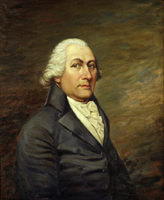
John Langdon
by Hattie Elizabeth Burdette (1872 - 1955)
Oil on canvas, 1916
Sight measurement
Height: 29.25 inches
(74.3 cm)
Width: 24.25 inches (61.6
cm)
Signature (lower right corner): HEBurdette
Cat. no. 32.00023.000
Biography of John Langdon
In submitting a resolution in 1916 authorizing the commission
of a portrait of John Langdon, Senator Jacob Gallinger of
New Hampshire commented that, as the first president pro tempore
of the Senate, "Langdon deserved some recognition on the part
of the Senate of the United States." [1] Artist Hattie Burdette,
who was educated at Washington, D.C.-area art schools, was
selected to paint the portrait. Burdette's likenesses of George
Washington and General Lafayette had been exhibited in Paris
at the French Colonial Exposition of 1931; other works by
her were held by the Navy Department and by Washington and
Lee University in Virginia.
The artist also produced a number of informal charcoal character
portraits of politicians, which were used for campaign purposes.
Burdette's oil of John Langdon for the U.S. Capitol is believed
to be based on an historic engraving of the senator by Samuel
Sartain, after an 18th-century pastel by James Sharples, Sr.
A notice in the Washington D.C. Sunday Star of October 15,
1916, described the completed portrait: "It is a strong face
with well defined features, but kindly expression." [2] The
painting was accepted by the Joint Committee on the Library
the same year.
A Revolutionary- and Federal-era leader, New Hampshire native John
Langdon was one of the first two senators from his state. Born in
Portsmouth, he became a successful owner of seagoing merchant vessels,
and he served as a member of the Continental Congress in 1775 and
1776. A year later, while Speaker of the New Hampshire house of
representatives, he was credited with saving the colonial forces
from disaster. Langdon personally financed the New Hampshire militia,
making possible the defeat of the British at the Battle of Bennington.
With General John Burgoyne's troops threatening from the west, the
state lacked an adequate treasury to defend itself. At a troubled
meeting of the state assembly, Langdon arose and pledged "$1,000
in hard money" and $3,000 in silver and saleable rum to create the
necessary fund.
Langdon was chosen president of New Hampshire in 1785, was a delegate
to the federal Constitutional Convention in 1787, and became governor
of New Hampshire in 1788. Elected to the U.S. Senate from New Hampshire
in 1788–-the first session under the federal Constitution–-he served
until 1801 and has the distinction of being the first president
pro tempore. From 1805 to 1809 he again served as governor of New
Hampshire. Declining the Democratic-Republican nomination for the
vice presidency in 1812, Langdon retired from politics. He died
in Portsmouth in 1819.
For Further Information Please Visit This Site: http://www.senate.gov/