- Oil Painting »
- Joseph Gales
Joseph Gales
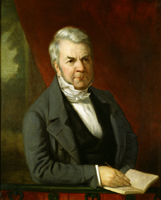
Joseph Gales
by George Peter Alexander Healy (1813 - 1894)
Oil on canvas, 1844 ca.
Sight measurement
Height: 35.63 inches
(90.5 cm)
Width: 28.75 inches (73
cm)
Unsigned
Cat. no. 31.00016.000
Biography of Joseph Gales, Jr.
Shortly after the retirement of Joseph Gales from the National
Intelligencer, an admirer wrote, "As an editor, Mr. Gales
has few equals in the United States, and no superior." The
source, one Oliver H. Smith, further volunteered that Henry
Clay had considered Gales, after John Quincy Adams, to be
the man who "knew the most of our country, and its prominent
men." Smith offered a description of Gales that accords well
with the Senate's portrait by George P.A. Healy. In physique,
he wrote, "Mr. Gales is about the common hight [sic], well
made, broad face, remarkably large head, prominent, square
forehead, heavy coat of hair. . . ." [1] This handsome, assured
portrait commemorates Gales's role in the famous Senate debate
between Robert Young Hayne and Daniel Webster in 1830. South
Carolina's nullification doctrine, formulated by Vice President
John C. Calhoun and put forward in a Senate speech by Senator
Hayne, posed an important test for the Union.
Webster, having decided to answer Hayne, asked Gales to report
his speech. Gales's shorthand notes, as copied by his wife
and revised by Webster, became the historical source for the
instantly famous address. Gales soon thereafter adopted the
stirring closing words of Webster's reply to Hayne–-"Liberty
and Union, now and forever, one and inseparable!"–-and printed
them above his editorial column from that time forward. George
P.A. Healy was already a successful and prolific portraitist
when he created this likeness of Gales. The artist had shown
evidence of talent at an early age and was encouraged by the
prominent painter Thomas Sully. Healy later moved to Paris
and established himself as an internationally known portraitist
patronized by royalty and the upper class. He returned to
the United States in 1842 and spent much of his time in Washington,
D.C., on numerous portrait commissions.
A related historical painting by Healy, Webster's Reply to
Hayne, was originally commissioned by King Louis Philippe
of France. Healy had suggested the subject to the king in
the summer or fall of 1843. Louis Philippe envisioned a museum
in the former royal palace at Versailles that would be dedicated
to the ideals and individuals of modern republicanism in Europe
and America. To that end, he had already sent Healy back to
America in 1842 to paint portraits or copy existing portraits
of American statesmen for his museum. Webster's Reply to Hayne
was destined for the same site. But with the fall of Louis
Philippe in 1848, that project was suspended. In 1852 the
painting was exhibited at Faneuil Hall in Boston, where it
has remained. In his monumental canvas, painted some 20 years
after the event, Healy included not only the members who witnessed
the debates, but also individuals he knew or admired who were
never present.
He situated Joseph Gales, recorder of the historic event,
fairly prominently in the center background. Gales's portrait
is not a study for the large history painting, but a carefully
finished independent portrait derived from such a study. Artists
engaged on paintings that contained likenesses of many notable
individuals were frequently able to increase their earnings
by painting separate finished portraits commissioned by each
sitter. Webster's Reply to Hayne resulted in 135 such portraits.
Marie de Mare, granddaughter and biographer of the artist,
wrote, "As Healy hoped, many of the sitters ordered their
portraits as painted in the picture, and many ladies appeared
at his studio dressed in becoming 1830 costumes resurrected
from their attic trunks." [2] A number of the life studies
were painted during the spring and summer of 1844, and the
Senate's portrait of Joseph Gales is presumed to have been
made then. Gales later acquired the portrait, which became
a favorite likeness and remained in the family until the Senate
purchased it. Gales is pictured behind a balustrade, his forearm
resting on the rail.
The head is set high on the canvas, which helps to reinforce
the appearance that Gales is standing, although he is shown
only half-length. The notebook and pen he holds allude generally
to his profession as a recorder and reporter of congressional
debates, and circumstantially to his role in the Webster-Hayne
debate. Yet the setting created by Healy is more decorative
than specific to the Senate Chamber, where the debate took
place. A maroon drapery is behind Gales, pulled back to reveal
an abbreviated landscape of sky and trees. Against this dark
background, Gales's silver-gray hair and warm flesh tones
stand out strongly, and the expressive, intelligent head is
offset by the white and lilac cravat with a striking zigzag
stripe. For the next 50 years, Healy worked on both sides
of the Atlantic. His painting Franklin Urging the Claims of
the American Colonies before Louis XVI won a gold medal at
the Paris International Exposition of 1855, and he was the
first American artist invited to contribute a self-portrait
to the Uffizi Gallery in Florence. In failing health, Healy
moved back to America in 1892. He died two years later in
Chicago.
For a half century before the Civil War, Joseph Gales, Jr., played
a significant role in recording the debates of the U.S. Senate.
Gales was born in England and immigrated to the United States as
a child with his parents. He learned the printing trade and stenographic
skills, and in 1807 Gales moved to Washington, D.C., where he joined
the National Intelligencer newspaper and began reporting congressional
proceedings. When the Intelligencer's founder, Samuel H. Smith,
retired in 1810, Gales took over as owner and editor of the paper,
in partnership with his brother-in-law, William W. Seaton. At first,
Gales was the Senate's sole reporter, and Seaton reported on the
House of Representatives. The Intelligencer supported the Jefferson,
Madison, and Monroe administrations, and Gales and Seaton were selected
as the official printers of Congress from 1819 to 1829.
In addition to printing government documents, they began compiling
their reports of floor debates and publishing them in the Register
of Debates, a forerunner of the Congressional Record. Gales also
served as mayor of Washington, D.C., from 1827 to 1830. Gales and
Seaton flourished during the "Era of Good Feelings," a period of
relative political complacency, but after Congress was split between
the Whigs and Democrats, the partners lost their official patronage.
The National Intelligencer continued to be published until 1868;
Gales died in 1860 and Seaton retired in 1864.
For Further Information Please Visit This Site: http://www.senate.gov/