- Oil Painting »
- Justin Morrill
Justin Morrill
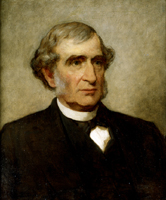
Justin Morrill
by Jonathan Eastman Johnson (1824 - 1906)
Oil on canvas, 1884
Sight measurement
Height: 24.75 inches
(62.9 cm)
Width: 20.75 inches (52.7
cm)
Signature (lower left corner): E. Johnson / 1884
Cat. no. 32.00005.000
Biography of Justin Smith Morrill
After securing a reputation as one of the finest genre painters
of the late 19th century, Eastman Johnson concentrated increasingly
on portrait painting in his later years. It was a more lucrative
subject matter in which he had considerable experience, and
after 1880 his distinguished roster of sitters included industrialists,
financiers, and politicians. Among them were two U.S. presidents,
Grover Cleveland (1891) and Benjamin Harrison (1895), whom
the federal government commissioned Johnson to paint. The
bust-length portrait of Senator Justin Morrill is arguably
superior to these larger presidential portraits, both in the
White House collection. Broadly painted and securely modeled,
Morrill's head is depicted against a backdrop of mottled,
modulated grays, a refreshing change from the preponderantly
dark and murky backgrounds of so many late-Victorian portraits.
The several grays in Morrill's hair, as well as his softly
painted muttonchops, play subtly against this lively background.
In Johnson, Morrill found a painter whose temperament was
well suited to his own. A New Englander like the senator,
Johnson evidenced empathy for the admirable legislator's character
in this sober portrait. Firmness of character is conveyed
through firmness of structure in the closely observed features.
Morrill's gaze follows the turn of his head, looking away
from the viewer and creating a thoughtful mood. Cornell University,
one of the institutions created by the Morrill Land Grant
College Act, had honored the "Father of the Agricultural Colleges"
by commissioning Eastman Johnson to paint Morrill's portrait
in 1883.
At the picture's unveiling that year in Ithaca, New York,
the senator remarked: "The sitting for a portrait, if I may
be pardoned for saying so, is rather an awkward business for
a modest man who can find anything else to do." [1] Morrill
ordered this excellent replica of the Cornell painting from
Johnson the following year for display in his Washington,
D.C., home. The house was built under the direction of Architect
of the Capitol Edward Clark, with decorated ceilings by artist
Constantino Brumidi. The Johnson portrait was in Morrill's
possession at the time of his death. In 1920 Louise S. Swan,
sister-in-law of the late senator, bequeathed the painting
to the United States to be hung in the Capitol.
After securing a reputation as one of the finest genre painters
of the late 19th century, Eastman Johnson concentrated increasingly
on portrait painting in his later years. It was a more lucrative
subject matter in which he had considerable experience, and after
1880 his distinguished roster of sitters included industrialists,
financiers, and politicians. Among them were two U.S. presidents,
Grover Cleveland (1891) and Benjamin Harrison (1895), whom the federal
government commissioned Johnson to paint. The bust-length portrait
of Senator Justin Morrill is arguably superior to these larger presidential
portraits, both in the White House collection.
Broadly painted and securely modeled, Morrill's head is depicted
against a backdrop of mottled, modulated grays, a refreshing change
from the preponderantly dark and murky backgrounds of so many late-Victorian
portraits. The several grays in Morrill's hair, as well as his softly
painted muttonchops, play subtly against this lively background.
In Johnson, Morrill found a painter whose temperament was well suited
to his own. A New Englander like the senator, Johnson evidenced
empathy for the admirable legislator's character in this sober portrait.
Firmness of character is conveyed through firmness of structure
in the closely observed features.
Morrill's gaze follows the turn of his head, looking away from the
viewer and creating a thoughtful mood. Cornell University, one of
the institutions created by the Morrill Land Grant College Act,
had honored the "Father of the Agricultural Colleges" by commissioning
Eastman Johnson to paint Morrill's portrait in 1883. At the picture's
unveiling that year in Ithaca, New York, the senator remarked: "The
sitting for a portrait, if I may be pardoned for saying so, is rather
an awkward business for a modest man who can find anything else
to do." [1] Morrill ordered this excellent replica of the Cornell
painting from Johnson the following year for display in his Washington,
D.C., home.
The house was built under the direction of Architect of the Capitol
Edward Clark, with decorated ceilings by artist Constantino Brumidi.
The Johnson portrait was in Morrill's possession at the time of
his death. In 1920 Louise S. Swan, sister-in-law of the late senator,
bequeathed the painting to the United States to be hung in the Capitol.
For Further Information Please Visit This Site: http://www.senate.gov/