- Oil Painting »
- Battle of Lake Erie
Battle of Lake Erie
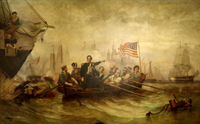
Battle of Lake Erie
by William Henry Powell (1823 - 1879)
Oil on canvas, 1873
Sight measurement
Height: 201.13 inches
(510.9 cm)
Width: 319.5 inches (811.5
cm)
Signature (lower left corner): W. H. Powell. / 1873
Cat. no. 33.00008.000
History of the Battle of Lake Erie
William Henry Powell, an Ohio artist who had studied with
Henry Inman in New York City, received a coveted commission
in 1847: the last of the historical paintings for the U.S.
Capitol Rotunda. His subject, Discovery of the Mississippi
by De Soto A.D. 1541, was completed in 1853. As Henry Tuckerman
wrote in his 1867 Book of the Artists, it was "a commission
bestowed upon him rather in deference to his Western origin
than because of priority of claim in point of rank or age."
[1] That is, the new political clout of the Northwest Territory
had made itself felt. This national success led his home state
to commission Powell in 1857 to paint Perry's Victory on Lake
Erie for the rotunda of the Ohio Statehouse in Columbus. The
work was completed in his New York City studio.
The artist let it be known that he had used as models men
from the Brooklyn Navy Yard and had sought authenticity in
all the nautical details of the picture, an effort for which
he was praised. The picture was installed in Columbus in 1865,
whereupon the Joint Committee on the Library commissioned
Powell, on March 2, 1865, for a painting "illustrative of
some naval victory," to be placed at the head of the east
stairway in the Senate wing of the Capitol. [2] It seems certain
that he was expected to repeat his Ohio Statehouse subject
on a larger scale. He did so, painting it in a temporary studio
inside the U.S. Capitol and completing it in 1873. For this
version, it appears that Powell used as models workers then
employed at the Capitol. Powell chose as his subject the moment
when Perry made his way from his severely damaged flagship,
the Lawrence, in a rowboat through enemy fire to the Niagara.
Powell enlarged the crew of the boat, showing six oarsmen,
a helmsman, Perry, and Perry's 13-year-old brother, Alexander,
who served as Perry's midshipman. Sources do not agree on
whether Alexander in fact accompanied his brother in the rowboat,
but it must have seemed an irresistible addition. In the painting,
Alexander grasps his brother's coat as if to pull him to sit,
as the helmsman also urges with a gesture. Perry does not
carry his battle flag; the artist chose instead to fly the
Stars and Stripes from the boat's bow. This is stirring, if
inaccurate, as the "colors" were not taken from the Lawrence.
One of the oarsmen is an African American. Although Tuckerman
identifies him as "Perry's black servant, Hannibal," who responds
to a near-hit in "evident consternation," his inclusion is
more likely dictated by the date of the painting–-immediately
post-Civil War and emancipation–-than by the reality of 1813.
[3] In addition to the heroic figures in the rowboat, Powell
shows three figures on the abandoned Lawrence, along with
a dead sailor in the flotsam between brig and boat and a doomed
figure in the water at the right side. To judge from the flags,
three British ships are clustered from the left to the center
in the background, and five American ships are grouped from
the center to the right. Many sailors are seen in those ships.
Powell's most expressive work is found in the indistinct background,
seen through gunsmoke and haze; in the water; and in the corpse
atop the tangled flotsam. Powell sacrifices spatial unity,
however, by ignoring the middle ground. Thus, the diagonal
that is meant to lead the eye from the Lawrence through the
rowboat to the distant Niagara fails to do so, despite Perry's
rhetorical pointing gesture. Although the commodore's heedless
action of standing in the boat had exposed him as he headed
for the Niagara, "Perry's luck" became legendary. The heroic
stance, as presented by Powell, may seem overdone to the modern
viewer, but it was not out of step with dramatic conventions
of the period.
For example, Emanuel Leutze's Washington Crossing the Delaware
portrays George Washington similarly. The Leutze canvas was
exhibited in New York in 1851 and again in 1853, and it was
all but universally praised for showing the hero's determined
purpose. Likewise, in describing Perry's action in the earlier
version of Powell's Perry's Victory on Lake Erie in the Ohio
Statehouse, Tuckerman revels, "[Perry]–-the central figure,
the soul of the picture–-is standing with outstretched arm,
and resolute and confident look, unconscious of his handsome
little brother, who tugs at his dress, or of the deprecating
gesture of the helmsman to make him sit down and avoid the
terrible exposure, of which, in the excitement of the moment,
he is unaware."
"We have met the enemy and they are ours—two ships, two brigs, one
schooner and a sloop." With this simple victory message to General
William Henry Harrison, commander of the U.S. forces in the Northwest
Territory, Commodore Oliver Hazard Perry announced his defeat of
the British fleet at the Battle of Lake Erie. This battle, one of
the most unusual in American naval history, ensured American control
of the Great Lakes during the War of 1812 and secured the country's
tenuous hold on the Northwest. Commodore Perry's victory was quickly
enshrined as one of the heroic military events of the early American
Republic.
The famous engagement on September 10, 1813, was initiated by Perry's
flagship Lawrence, named after James Lawrence, the commander of
the recently captured Chesapeake. Lawrence's dying words, "Don't
give up the ship," inspired the nation and Perry. Those words were
stitched onto Perry's battle flag, which flew over the Lawrence.
As the battle began, Perry placed the Lawrence at the head of his
fleet. The Caledonia and the Niagara, as well as six other ships
of various sizes, fell in behind. For reasons that have never been
determined, the faster Niagara remained behind the slower Caledonia,
and the Lawrence sailed into the battle virtually unsupported. Perry
was then forced to fight the entire British fleet with only the
Lawrence. After an intense bombardment of two and a half hours,
the Lawrence fought the British fleet to a standstill, though the
ship itself was severely damaged and four-fifths of its crew were
killed or wounded. In a daring move, Commodore Perry abandoned his
shattered ship and climbed into a rowboat with four crewmen. He
took with him his battle flag, which he draped over his shoulders.
The boat set out for the brig Niagara, braving heavy gunfire. Perry
boarded the ship, took command, and turned the Niagara directly
toward the British ships. The encounter was confusing and bloody,
but brief. The damaged British flagship Detroit attempted to swing
around, and its rigging became entangled with that of the Queen
Charlotte, rendering both ships helpless against the onslaught from
the Niagara. In short order, the smaller British ships also succumbed,
and a mere 15 minutes after boarding, Perry had achieved an extraordinary
victory. With it the British supply line to the Western frontier
was severed, and within the month the British and their Indian allies
were decisively defeated.
For Further Information Please Visit This Site: http://www.senate.gov/