- Oil Painting »
- Margaret Chase Smith
Margaret Chase Smith
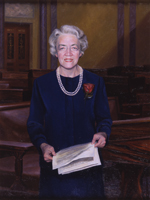
Margaret Chase Smith
by Ronald Frontin (1962 - Present)
Oil on canvas, 2002
Sight measurement
Height: 44.25 inches
(112.4 cm)
Width: 33.25 inches (84.5
cm)
Cat. no. 32.00041.000
Biography of Margaret Chase Smith
The decision to include a portrait of Margaret Chase Smith
in the U.S. Senate Collection was a result of the efforts
of Democratic Leader Tom Daschle of South Dakota, Republican
Leader Trent Lott of Mississippi, Senator Christopher Dodd
of Connecticut, and Senator Olympia Snowe of Maine. Each of
these senators had indicated concern over the limited number
of women represented in the Capitol's artwork. Senator Snowe
wrote to Senator Lott on June 24, 1999, that she could think
of no better way to remedy this "unfortunate situation" than
by displaying a portrait of Smith: "Senator Margaret Chase
Smith served our nation with dignity and honor, and her life
was a testimony to the possibilities that exist for women
in America.
What she proved is that it isn't necessarily gender which
makes the difference in public service–-it's dedication, energy,
perseverance, competence, ability, and the will to get the
job done." Lott responded: "The United States Capitol should
reflect the diverse history of this nation, and we must ensure
that all groups who have played a significant role in the
development of the country are appropriately honored." The
Senate Commission on Art subsequently approved the commissioning
of a portrait of Margaret Chase Smith. An advisory board was
established, composed of historians, curators, and Smith's
relatives, to review artists' submissions and provide recommendations
to the commission. Artist Ronald Frontin of Maine was selected
to paint Smith's portrait. Frontin received the commission
in 2000.
It was appropriate that a native paint this legendary daughter
of Maine, who herself was so passionate about her home state
and her constituents. Images were gathered from the Margaret
Chase Smith Library Center at the Norwood Institute in Skowhegan,
and the artist interviewed friends and colleagues of the senator
to gain a better understanding of her and her many accomplishments.
Frontin, particularly aware that the painting would hang among
a gallery of her male counterparts, sought to portray a powerful
image of Smith.
She is depicted at the height of her Senate career, seen with
her signature pearls and red rose. Frontin, who studied at
the Philadelphia College of Art and later apprenticed with
artist Nelson Shanks, paints the Maine landscape. He often
shows people in their daily activities, and he has become
increasingly known for his portraits of prominent Maine business
leaders, judges, and politicians.
Despite these many achievements, Smith's most enduring legacy was
her courageous "Declaration of Conscience" against the politics
of "fear, ignorance, bigotry, and smear" that she attributed to
Wisconsin Senator Joseph McCarthy. "If I am to be remembered in
history," she later declared, "it will not be because of legislative
accomplishments but for an act I took as a legislator in the United
States Senate when on June 1, 1950 I spoke in the Senate in condemnation
of McCarthyism...." [1] The rose that Smith wore daily in her lapel
was emblematic of her long crusade to have the rose declared the
official flower of the United States. Her efforts were initially
thwarted by Senate Republican Leader Everett M. Dirksen, who supported
the marigold.
It was not until 1987, long after Senator Smith's retirement, that
Congress finally designated the rose as the national flower. In
1964 Smith declared her candidacy for the presidency. She entered
several Republican primaries and became the first woman to have
her name placed in nomination at a major party convention. Smith
continued in the Senate until 1973 and having been defeated for
reelection, retired to Skowhegan. She was awarded the Presidential
Medal of Freedom in 1989 and died in 1995 at the age of 98. The
first woman to win election to both houses of Congress, Margaret
Chase Smith was known for her rugged political independence and
the red rose she wore daily. Born in Skowhegan, Maine, in 1897,
she attended local schools and worked as a grade school teacher,
telephone operator, newspaper circulation manager, and business
manager of a textile mill.
In 1925 she became president of the Maine Federation of Business
and Professional Women's Clubs. When she married Clyde H. Smith
in 1930, she turned her attention to public service and became a
member of the Republican state committee. When her husband was elected
to the U.S. House of Representatives in 1936 as a Republican, she
became his secretary, office manager, and political confidante.
After Congressman Smith died of a heart attack in 1940, Margaret
Chase Smith won a special election to succeed him and remained in
the House for four terms. During World War II, she introduced legislation
to give women permanent status in the military. Smith won a U.S.
Senate seat in 1948.
During her 24-year Senate career, she became an expert in military
affairs and aeronautics and served as the ranking Republican on
both the Armed Services Committee and the Aeronautical and Space
Sciences Committee. One NASA director commented that if it were
not for Margaret Chase Smith, we never would have placed a man on
the Moon. Smith became the first woman elected to a leadership post
in the Senate: chair of the Senate Republican Conference. She also
set a record for casting the largest number of consecutive roll
call votes—2,941—which ended when she missed a vote because of back
surgery.
For Further Information Please Visit This Site: http://www.senate.gov/