- Oil Painting »
- General Marion
General Marion
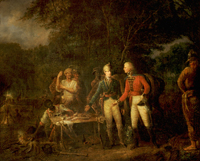
General Marion Inviting a British Officer to Share His Meal
by John Blake White (1781 - 1859)
Oil on canvas, n. d.
Sight measurement
Height: 24.5 inches (62.2
cm)
Width: 29.5 inches (74.9
cm)
Unsigned
Cat. no. 33.00002.000
More on General Marion Inviting a British Officer to Share his Meal
The oil on canvas painting, General Marion Inviting a British
Officer to Share His Meal, by South Carolina artist John Blake
White, was presented to the Senate in 1899. According to the
artist's son, Octavius A. White: "the figure of Marion is
a portrait from memory, as my father, when a boy, knew him
well. Marion's farm adjoined the plantation of my grandfather."
The Senate accepted the work by resolution on February 17,
1899. At that time, Octavius White also presented two other
paintings by his father: Sergeants Jasper and Newton Rescuing
American Prisoners from the British and Mrs. Motte Directing
Generals Marion and Lee to Burn Her Mansion to Dislodge the
British. Two years later, Octavius White donated another work
by his father, The Battle of Fort Moultrie.
In a letter accompanying the first three pictures, he wrote
that the series reflects "the heroic spirit which animated
our fathers in the stormy days of the Revolution." The artist
has painted the red-coated British officer and Marion at right
center, with a horse. Marion wears a plumed shako. His soldiers
present an amusingly motley crew. Of special interest is the
African American man behind the table, holding a small pan
and, with his right hand, roasting sweet potatoes in the fire.
The figure has been recently identified as Oscar Marion, a
slave of Francis Marion who accompanied the General into war.
While Oscar Marion is seen cooking the meal, Samuel Weaver's
pension application maintains that Weaver himself, a white
soldier, was the one who cooked the meal.
The makeshift table has a number of sweet potatoes on it,
and Marion gestures toward them. During his lifetime, White
executed several versions of the scene; similar paintings
are held by the Museum of Fine Arts, Boston, the South Caroliniana
Library, Columbia, and the Chicago Historical Society. White's
portrayal of the sweet potato meal was made into a mezzotint
print by John Sartain in 1840 for the Apollo Association for
the Promotion of the Fine Arts in the United States, a group
that listed as one of its goals "the cultivation and diffusion
of correct taste in the fine arts." [1] The print was the
first in a series of engravings made from American paintings
that were distributed to the nearly one thousand association
members.
The image also appeared on Confederate banknotes issued in
1861 by South Carolina. The painting was exhibited at the
National Academy of Design in 1837 and at the Apollo Gallery
in 1838 and 1839. The exhibition catalogue described it this
way: In a surprising piece of historical revisionism, James
P. Truluck, Jr., a descendant of the alleged British officer,
has raised doubts about this interpretation, as well as the
officer's identity. Truluck has proposed that the roles of
Marion as host and the officer as guest were actually reversed.
According to Truluck (in an 1989 article in Carologue, the
journal of the South Carolina Historical Society), Captain
John Brockington, Jr.–-a landowner, slave-owner, and Tory
sympathizer, who had fought against the "Swamp Fox"–-was the
legendary officer.
Brockington was among those Tories to be banned to Nova Scotia,
their properties seized after victories by the American forces
in South Carolina. Brockington returned to South Carolina
to plead his case in person before the state senate, refuting
his former life as a Tory and promising to repay claims against
him. He was eventually pardoned. On his way home, he and his
slaves traveled through swamps for safety. It was Captain
Brockington, posits Truluck, who was cooking his dinner of
sweet potatoes when the "Swamp Fox" found him. In this version
of the story, Brockington then invited Marion to share his
meal–-and Marion invited Brockington to join his army!
General Francis Marion, the "Swamp Fox," was one of the most dashing
figures of the American Revolution. He sabotaged the communication
and supply lines of the British forces in South Carolina in a series
of surprise attacks. With his small band of poorly equipped men
trained in guerrilla warfare, Marion lived off the land and hid
in the swamps to evade the enemy. While camped on Snow's Island,
South Carolina, about 1781, the general was said to have received
a British officer who had been sent to arrange an exchange of prisoners.
Their negotiations completed, Marion invited the visiting officer
to stay for a meal.
There are at least three differing accounts of what may have transpired,
but recent scholarship has uncovered a document that may shed light
on the event. This document is the application of Samuel Weaver,
a militiaman in North Carolina and Virginia, for a Revolutionary
War pension. Weaver's sworn statement, as recorded by a justice
of the peace, suggests that he was present at the Snow's Island
encampment: Legend says that the officer was surprised by the modest
fare, as well as the simple attire and mode of existence that he
found in the American camp.
He was equally surprised that the American soldiers drew no wage
and provided their own rations. General Marion explained that he
and the Americans were willing to make these sacrifices to fight
for liberty. The British officer was said to be so moved by the
Americans' dedication that soon thereafter he resigned his commission
and switched allegiances, declaring that it was impossible to defeat
soldiers who would serve "without pay, and almost without clothes,
living on roots and drinking water; and all for Liberty!" [2] He
reportedly served for the last six months of the war as a private
under Marion, who later fought with General Nathanael Greene at
the Battle of Eutaw Springs, forcing the British retreat from South
Carolina.
For Further Information Please Visit This Site: http://www.senate.gov/