- Oil Painting »
- Robert Alphonso Taft
Robert Alphonso Taft
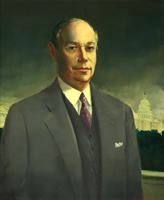
Robert A. Taft by Rudolf Anton Bernatschke
by Rudolf Anton Bernatschke (1913 - Present)
Oil on canvas, 1953
Sight measurement
Height: 29.5 inches (74.9
cm)
Width: 24.5 inches (62.2
cm)
Signature (lower right corner): Bernatschke 53
Cat. no. 32.00030.000
Biography of Robert Alphonso Taft
Rudolf Bernatschke completed this portrait of Robert Taft
in 1953, the year of Taft's death. Just three weeks before
the senator died, Bernatschke had the opportunity to show
the painting to Taft, who thought it "flattering." [1] Taft
made one request of the artist, however: He asked that the
color of his hair at the temples be changed from white to
gray.
The Austrian-born Bernatschke, who had immigrated to the United
States 18 years earlier, was noted by then for portraiture,
landscapes, and still lifes with vivid color and crisp delineation.
Bernatschke painted the Taft portrait as a personal tribute,
proclaiming himself an "admirer of Senator Taft and a believer
in the principles for which he stood." [2] In 1959 the artist
presented the painting to Senate Republicans for display in
the Republican leader's suite of offices in the Capitol.
Senator Everett M. Dirksen of Illinois, Republican leader
at the time, accepted the painting at a bipartisan ceremony
in the Old Supreme Court (now the Old Senate) Chamber, declaring
that he would be honored to have this portrait of the "great
leader" hang in his office. [3] During the ceremony, Senate
Democratic Leader Lyndon B. Johnson also praised Taft as a
"brave and fearless leader." [4] The painting hung in the
Republican leader's suite until 1969.
Born in Cincinnati, Ohio, Robert Alphonso Taft, the son of President
William Howard Taft, would one day become the leading spokesman
for conservative opinion in the United States. Elected to the U.S.
Senate in 1938, Taft opposed President Franklin D. Roosevelt's New
Deal programs and efforts to expand the federal government at the
expense of state and local jurisdictions. In Congress, Taft chaired
the Senate Labor and Public Welfare Committee, where he helped write
the Labor-Management Relations Act of 1947.
Known as the Taft-Hartley Act, it placed controls on labor unions
and prohibited "closed shops." As a member of the Foreign Relations
Committee, Taft spoke out on international issues, especially criticizing
President Harry S. Truman's Korean and Chinese policies. Identified
as "Mr. Republican," Taft enjoyed wide respect for his fairness,
courage, and integrity, despite his often controversial positions.
Taft was an unsuccessful candidate for the Republican presidential
nomination in 1940, 1948, and 1952. During his brief service as
Senate majority leader in 1953, he became a prominent advisor to
President Dwight D. Eisenhower. Illness forced Taft to relinquish
active Senate leadership in June of 1953, and he died the following
month.
For Further Information Please Visit This Site: http://www.senate.gov/