- Oil Painting »
- Robert Marion La Follette
Robert Marion La Follette
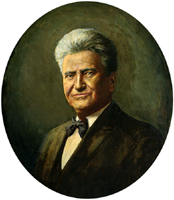
Robert M. La Follette
by Robert Chester La Follette
Oil on canvas, 1958
Sight (oval) measurement
Height: 22.63 inches
(57.5 cm)
Width: 19.5 inches (49.5
cm)
Unsigned
Cat. no. 32.00010.000
Biography of Robert Marion La Follette
In 1955, by resolution of the Senate, the Special Committee
on the Senate Reception Room was established to select five
outstanding persons who had served as members of the Senate.
Their likenesses would be placed in the room's medallion ovals
that were left vacant in the mid-19th century by artist Constantino
Brumidi. Chaired by Senator John F. Kennedy of Massachusetts,
the committee sought the counsel of historians, political
scientists, former senators, and other public figures in the
selection process. The committee had little trouble selecting
the first three senators–-both the members and their historical
advisory panel unanimously chose the "Great Triumvirate" of
Henry Clay, Daniel Webster, and John C. Calhoun. However,
the committee had far greater trouble selecting the final
two senators. The historians polled selected George Norris,
a Nebraska Republican, but Norris was still too controversial
a figure to meet the committee's requirement for selection
by unanimous vote.
After much deliberation, the committee chose Robert M. La
Follette, Sr., of Wisconsin and Robert A. Taft, Sr., of Ohio
for the remaining paintings. Artist Chester La Follette, son
of William L. La Follette, the senator's first cousin, actively
sought the commission to paint the senator's portrait for
inclusion in the "Five Outstanding Senators" series. He based
his representation on an earlier study he had made, which
he described as a "free adaptation" of a photograph taken
in 1922 by John A. Glander of Manitowoc, Wisconsin. In addition,
according to a nephew writing in the Columbia, South Carolina,
newspaper The Columbia (SC) State in 1996: "Uncle Chester
remembered seeing his cousin speaking in Yankee Stadium and
obtained a press photo that gave a direct frontal view, providing
a different perspective from the [Glander] photo." [1] The
portrait was executed in the artist's New York City studio
and then applied to the wall of the Senate Reception Room
at the same time as the four other portraits. Artist Allyn
Cox supervised the project and final placement of the paintings
in the fall of 1958. A formal unveiling ceremony was held
on March 12, 1959.
A leader in the 20th-century Progressive movement, Robert Marion
La Follette was a U.S. representative, governor, and U.S. senator
from Wisconsin, and an unsuccessful candidate for the presidency.
La Follette was born in the town of Primrose, Wisconsin, the son
of settlers from Kentucky. Admitted to the bar in 1880, he entered
the U.S. House of Representatives in 1885. After three terms in
the House, he was elected governor of Wisconsin and served from
1901 to 1906. As governor, La Follette pushed for a direct primary
system, tax reform legislation, railroad rate control, and other
measures known as the "Wisconsin idea," collectively aimed at weakening
the control of party bosses and turning over public administration
to popularly elected leaders. Nicknamed "Fighting Bob," La Follette
continued to champion Progressive causes during a Senate career
extending from 1906 until his death in 1925.
He strongly supported the 17th Amendment, which provided for the
direct election of senators, as well as domestic measures advocated
by President Woodrow Wilson's administration, including federal
railroad regulation and laws protecting workers rights. La Follette
worked to generate wider public accountability for the Senate. He
advocated more frequent and better publicized roll call votes and
the publication of information about campaign expenditures. Early
in his Senate career, the Wisconsin Republican broke with leaders
of the Grand Old Party and rarely voted along party lines thereafter.
In 1911 he helped found the National Progressive Republican League,
whose members rallied around him as the logical candidate to wrest
the Republican presidential nomination from President William Howard
Taft. However, La Follette lost his bid when many supporters switched
their allegiance to Theodore Roosevelt who, after failing to win
the Republican nomination, ran unsuccessfully on the third-party
Progressive, or Bull Moose, ticket in 1912. La Follette led a small
but influential group of Progressives in the Senate. As a result
of the close margin between the two major parties, the Progressives
held power out of proportion to their small numbers. Also the leader
of the pacifist block in the Senate, La Follette opposed American
involvement in World War I. In 1924 he was nominated for president
by the League for Progressive Political Action and polled five million
votes. Exhausted by the rigors of the campaign, La Follette died
the following year in Washington, D.C. His son, Robert M. La Follette,
Jr., succeeded him in the Senate, thus carrying on the reform tradition.
For Further Information Please Visit This Site: http://www.senate.gov/