- Oil Painting »
- Robert Taft
Robert A. Taft by Deane Keller
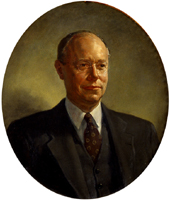
Robert A. Taft by Deane Keller
by Deane Keller
Oil on canvas, 1958
Sight (oval) measurement
Height: 22.63 inches
(57.5 cm)
Width: 19.5 inches (49.5
cm)
Unsigned
Cat. no. 32.00008.000
Biography of Robert Alphonso Taft
Yale University Art Professor Deane Keller was recommended
by Robert Taft's brother Charles to paint the senator's portrait
for one of the oval wall panels in the Senate Reception Room
of the Capitol. Keller, of Hamden, Connecticut, was considered
the "unofficial artist" of Yale, Robert Taft's alma mater.
Altogether, Keller executed more than 75 portraits of Yale
faculty members. Apart from studying three years in Rome and
serving in World War II, Keller spent his entire adult life
at the university.
In a career that included more than 800 commissions, he was
said to have "captured the images of some of the 20th century's
most prominent politicians and academicians." Taft and Wisconsin
Senator Robert M. La Follette, Sr. were selected by the Special
Committee on the Senate Reception Room to be among the five
outstanding senators whose portraits would embellish the long-vacant
oval medallions in the room.
The two 20th-century senators, so honored after much debate
during the selection process, joined the easily agreed-upon
threesome of Henry Clay, Daniel Webster, and John C. Calhoun.
The Taft image was painted on canvas at the artist's studio
in Connecticut and finished in the Capitol after the canvas
was positioned on the room's east wall. In addition to completing
a second portrait of Robert Taft, now at the Taft School in
Watertown, Connecticut, Keller executed paintings of Presidents
Herbert Hoover and William Howard Taft.
Born in Cincinnati, Ohio, Robert Alphonso Taft, the son of President
William Howard Taft, would one day become the leading spokesman
for conservative opinion in the United States. Elected to the U.S.
Senate in 1938, Taft opposed President Franklin D. Roosevelt's New
Deal programs and efforts to expand the federal government at the
expense of state and local jurisdictions. In Congress, Taft chaired
the Senate Labor and Public Welfare Committee, where he helped write
the Labor-Management Relations Act of 1947. Known as the Taft-Hartley
Act, it placed controls on labor unions and prohibited "closed shops."
As a member of the Foreign Relations Committee, Taft spoke out on
international issues, especially criticizing President Harry S.
Truman's Korean and Chinese policies. Identified as "Mr. Republican,"
Taft enjoyed wide respect for his fairness, courage, and integrity,
despite his often controversial positions. Taft was an unsuccessful
candidate for the Republican presidential nomination in 1940, 1948,
and 1952. During his brief service as Senate majority leader in
1953, he became a prominent advisor to President Dwight D. Eisenhower.
Illness forced Taft to relinquish active Senate leadership in June
of 1953, and he died the following month.
For Further Information Please Visit This Site: http://www.senate.gov/