THE SCHOOL OF ATHENS:
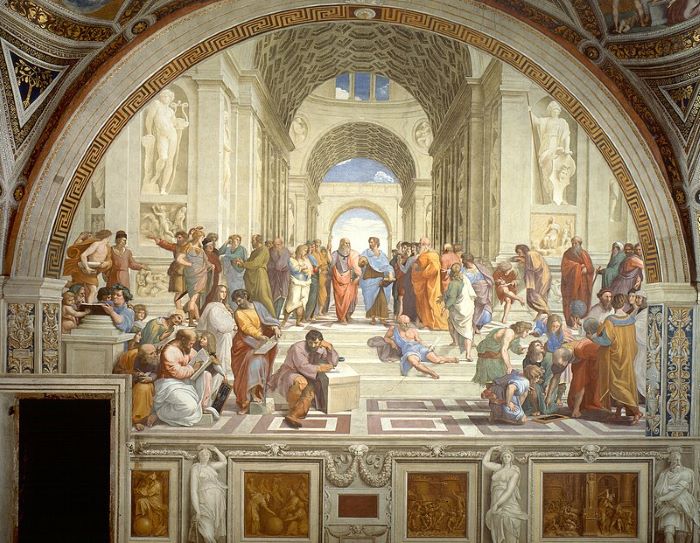
"The School of Athens" is a masterpiece painted by the Italian Renaissance artist Raphael around 1509-1511. Commissioned as part of a series of frescoes for the Vatican's Apostolic Palace, this particular work is located in the Stanza della Segnatura.
The painting is a representation of a gathering of great philosophers, mathematicians, and scholars from different periods of history, all placed in an idealized classical setting.
The two central figures, Plato and Aristotle, stand at the forefront, engaging in discussion and symbolizing the fundamental philosophical divide between idealism and empiricism. Raphael ingeniously populates the scene with various historical and contemporary figures, blending classical and Renaissance influences. Figures like Pythagoras, Euclid, and Ptolemy are depicted alongside contemporaries of Raphael, such as Leonardo da Vinci and Michelangelo, subtly bridging the gap between the ancient and modern worlds.
THE SCHOOL OF ATHENS
Raphael's careful selection of philosophers spans various epochs and cultural traditions. Figures such as Pythagoras, Euclid, and Ptolemy represent mathematics and science, while Socrates, Heraclitus, and Diogenes embody different philosophical schools. The inclusion of Zoroaster and other non-Greek philosophers reflects Raphael's appreciation for the interconnectedness of knowledge across cultures. The architectural setting of "The School of Athens" is a masterful creation in itself. The space is an idealized classical structure with arches, columns, and a domed ceiling.
The use of linear perspective creates a sense of depth, drawing the viewer into the intellectual world of the philosophers. The architecture serves as a symbolic backdrop, representing the classical ideals of order, harmony, and balance. The placement and gestures of the figures contribute to the dynamic and harmonious composition. The arrangement of the philosophers creates a visual rhythm, guiding the viewer's gaze through the scene. The figures are engaged in various activities, from animated discussions to introspective contemplation, capturing the diverse aspects of intellectual inquiry. One notable aspect of the fresco is the inclusion of self-portraits. Raphael cleverly inserts himself into the scene, standing on the right side, wearing a black hat and looking directly at the viewer.
This self-portrait serves as a testament to Raphael's humility and acknowledgment of his role within the continuum of artistic and intellectual history. The use of color in "The School of Athens" is subtle yet effective. The warm tones of the figures' clothing contrast with the cooler hues of the architecture, creating a harmonious and balanced palette. The gradations of light and shadow contribute to the three-dimensionality of the scene, adding a sense of realism to the idealized setting. Symbolism abounds in "The School of Athens." The figures are not randomly placed; each philosopher and their gestures convey specific ideas. ABOUT THE AUTHOR:
https://www.reviewpainting.com/ Raphael .htm