THE GLEANERS :
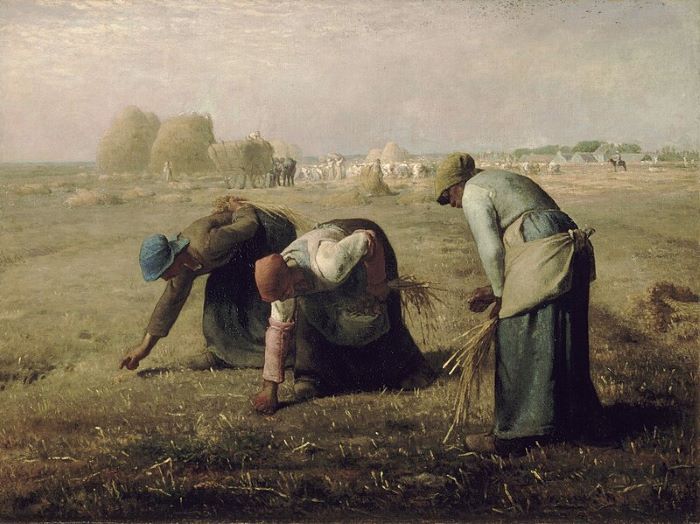
"The Gleaners" is a renowned painting by French artist Jean-François Millet, completed in 1857. This masterpiece is a seminal work of the Realist movement, depicting three peasant women stooping to gather leftover grains from a harvested wheat field. The painting captures the laborious nature of their work and serves as a social commentary on the challenges faced by rural laborers in 19th-century France.
Millet's composition emphasizes the dignity of the gleaners and their connection to the land, portraying them as resilient figures in the face of economic hardship. The women are rendered with a sense of strength and purpose, their stooped postures conveying both the physical exertion and the necessity of their task. "The Gleaners" sparked considerable controversy upon its exhibition due to its perceived social and political implications.
THE GLEANERS
The composition of "The Gleaners" is both simple and profound. Three female figures dominate the foreground, their bent forms echoing the curves of the harvested field. The women are meticulously rendered, emphasizing their physical strength, resilience, and the repetitive nature of their task. The warm, earthy tones of their clothing harmonize with the muted colors of the landscape, creating a sense of unity and connection with the natural world. The act of gleaning, historically associated with poverty and marginalization, is elevated by Millet's treatment.
The women are not depicted as pitiable figures but as strong, capable individuals engaged in essential work. Their labor becomes a symbol of endurance and resourcefulness in the face of economic hardship. The painting's depth of field allows viewers to observe the entire process of gleaning. In the background, the harvested field stretches out to the horizon, revealing the vastness of the rural landscape. The gleaners carefully collect leftover wheat grains, using their hands to comb through the earth, embodying a connection between humanity and the land. Millet's attention to detail extends to the depiction of the gleanings themselves.
The scattered golden grains are rendered with precision, creating a visual rhythm that underscores the repetitive and cyclical nature of agricultural labor. This attention to detail contributes to the overall realism of the painting, allowing viewers to immerse themselves in the daily lives of the gleaners. The symbolism embedded in "The Gleaners" invites contemplation. Gleaning was traditionally associated with charitable acts, reflecting a sense of community and shared resources. However, as the Industrial Revolution transformed agricultural practices, traditional ways of life became increasingly challenged. Millet's painting captures a moment in time when the rural landscape was undergoing significant changes, and the role of the peasant class was being redefined.ABOUT THE AUTHOR
https://www.reviewpainting.com/Jean-Francois Millet.htm