- Oil Painting »
- Thomas Jefferson
Thomas Jefferson
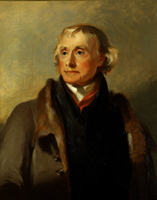
Thomas Jefferson
by Thomas Sully (1783 - 1872)
Oil on canvas, 1856
Sight measurement
Height: 28.5 inches (72.4
cm)
Width: 23.63 inches (60
cm)
Unsigned
Cat. no. 31.00006.000
Biography of Thomas Jeffersons
American artist Thomas Sully traveled to Monticello in March
1821 to capture a likeness of Thomas Jefferson. Sully was
on commission to paint a portrait of Jefferson for the U.S.
Military Academy at West Point, which Jefferson established
while president. Jefferson lightly observed that Sully might
find "the trouble of his journey and the employment of his
fine pencil, as illy bestowed" on his elderly person. But
Sully, after two weeks of sketching and painting the great
man at Monticello, "left the place with the greatest reluctance."
[1] The immediate result of that visit was a half-length oil
painting (the torso not completed until 1830) of the former
president that is one of Sully's finest achievements. Sully
subsequently sold the painting to William Short, Jefferson's
former secretary. Short, in turn, bequeathed the picture to
the American Philosophical Society, a scientific organization
that Jefferson had presided over from 1797 to 1814.
This painting, in Philosophical Hall, Philadelphia, served
as the study for the West Point commission–a full-length portrait,
still owned by the Academy, which Sully finished the following
year. Sully painted two replicas of the half-length painting
in 1856. Both are listed in a hand-written register of portraits
created by Sully. No. 884 in the register was painted for
the actor Edwin Forrest between December 6 and 11, and No.
885 was painted "for myself" ("second copy") between December
11 and 29. No. 885, which remained in Sully's possession during
his lifetime, must be the one offered for sale to Congress
in 1872 by the artist's grandson, Garrett C. Neagle, for $300.
The Joint Committee on the Library took no action, and after
Sully's death later that year Neagle raised his asking price
to $500. The committee haggled, and the painting was acquired
for $200 in 1874.
In 1856 Sully was in his seventies, which probably accounts
for a noticeable hardness in the handling and harshness in
the coloring of the Senate's painting, characteristics not
found in the original. Despite the loss of the artist's youthful
finesse, the replica retains the extraordinary dignity and
repose of the original. The magisterial head, with prominent
brow and large, deep-set eyes, is serenely poised above the
torso. Jefferson is wearing a white shirt, a black coat, a
glimpse of a bright crimson waistcoat, and a greatcoat trimmed
with sable furs given to him by Tadeusz Kosciuszko, who had
received it from Czar Paul I on his release from prison in
St. Petersburg. The waistcoat provides an effective note of
color, repeated in the shadows above the eyelids. Behind the
head, Sully has painted a vague sky effect with his favorite
robin's egg blue, mingled with tawny hues. In several of Sully's
Jefferson portraits (though not the Senate version), the subject
stands majestically beside a marble column from the U.S. House
of Representatives.
The symbolism is significant: Jefferson was closely involved
in the construction of the new Capitol building, and he insisted
that architect Benjamin Henry Latrobe use the Corinthian order
for the new House Chamber. The president was keenly aware
of the importance of evoking the Roman aesthetic and its association
with a republican form of government. Thomas Sully was the
leading American portrait painter in the romantic style during
the first half of the 19th century. He was born in England,
moved to the United States with his family at the age of nine,
and lived in both South Carolina and Virginia during his youth.
Sully studied briefly with Gilbert Stuart in Boston and in
1808 took up permanent residence in Philadelphia. He later
traveled to London, where he was influenced by the work of
Benjamin West and Sir Thomas Lawrence. On his return to Philadelphia,
Sully began a long and successful career painting the fashionable
men and women of the day; he produced more than 2,000 portraits
during his 70-year career.
One important replica by Sully of his half-length portrait
of Jefferson–this one a bust-length likeness–was formerly
owned by President James Monroe and is now on permanent loan
to the University of Virginia from the Jefferson Literary
and Debating Society. The location of another Jefferson portrait,
once owned by the Marquis de Lafayette, is unknown. Sully's
likenesses of Jefferson became standard, and many later artists
and engravers replicated them. A painting of Andrew Jackson
attributed to Thomas Sully is also in the Senate. In addition
to his portraits, Sully created landscapes, history paintings,
and fanciful compositions. He was a respected teacher, and
his treatise on painting methods, Hints to Young Painters,
was published posthumously.
Father of the Declaration of Independence, the multi-talented Thomas
Jefferson achieved perhaps his greatest renown as a political theorist
and spokesman for democracy. He was born in what is now Albemarle
County, Virginia, studied law, and was admitted to the Virginia
bar in 1767. He served in the Virginia house of burgesses from 1769
until it disbanded in 1774. Virginia sent Jefferson to the second
Continental Congress, where he was elected to the committee charged
with drafting a declaration of independence. Although he was assisted
by John Adams, Benjamin Franklin, and others, Jefferson was the
document's primary author. Jefferson served in the Virginia state
legislature from 1776 to 1779, and he was governor between 1779
and 1781. After the Revolutionary War, he carried out various assignments
abroad, including serving as minister to France. When he returned
home in 1789, he accepted the post of secretary of state in George
Washington's first administration. Following a brief retirement
from public service, Jefferson, representing the Republicans, ran
for the presidency in 1796.
According to the election rules of the day, he finished second to
Federalist John Adams and, as a result, was designated the nation's
second vice president. This outcome, in which the president and
vice president represented opposing parties, would prove unique
in U.S. history. As vice president, Jefferson devised the Manual
of Parliamentary Practice guidebook for the Senate's presiding officer
that is still relevant today. Meanwhile, he prepared for a second
run for the presidency in 1800. This time, he tied in electoral
votes with his opponent, Aaron Burr. After 36 ballots, the House
of Representatives chose Jefferson as the country's third president.
The most significant accomplishment of Thomas Jefferson's first
administration was the Louisiana Purchase in 1803, which doubled
the size of the United States.
Reelected triumphantly the following year, Jefferson spent much
of his second term attempting to protect American rights against
British and French interests by instituting a trade embargo, an
effort that proved largely unsuccessful. In 1809 he retired to his
rural Virginia home, Monticello. There, he championed higher education
by founding the University of Virginia, and pursued wide-ranging
interests in the arts and sciences. Jefferson is considered one
of the most versatile men of his age, one much respected for his
significant contributions to political statesmanship and philosophy.
He is also recognized for his scholarship and skill in architecture,
music, botany, and agriculture. Jefferson's personal library was
the foundation for the Library of Congress.
For Further Information Please Visit This Site: http://www.senate.gov/