- Oil Painting »
- Ulysses Grant
Ulysses S. Grant
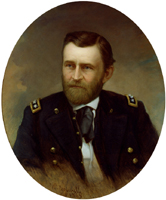
Ulysses S. Grant
by William F. Cogswell (1819 - 1903)
Oil on canvas, 1868
Sight (oval) measurement
Height: 29 inches (73.7
cm)
Width: 24 inches (61
cm)
Signature (lower left): W. Cogswell / 1868
Cat. no. 31.00009.000
Biography of Ulysses S. Grant
Artist William Cogswell painted this portrait of President
Ulysses S. Grant the year before Grant began his first term
in office. According to Laura Cooke, the widow of Henry Cooke
(the original owner of the portrait), Cogswell worked in a
studio improvised at the Cooke family home in Washington,
D.C. Grant was an intimate friend and frequent visitor there.
Laura Cooke reportedly termed the painting "a most speaking
likeness to the General, so considered by himself, and all
who saw it." Henry Cooke's brother, New York financier Jay
Cooke, called the Cogswell portrait "the best picture of Grant
in existence." The Senate acquired the painting in 1886, one
year after Grant's death.
A favorite during the Grant administration, the self-trained
Cogswell also painted a large group portrait of the president
and his family, now in the collection of the Smithsonian Institution.
The artist had a studio in New York City for many years and
also traveled extensively; in Hawaii he painted portraits
of King Kalakaua and Queen Liliuokalani. Cogswell portrayed
other prominent individuals, including President William McKinley,
General Philip Sheridan, naturalist Louis Agassiz, California
Governor Leland Stanford, and banker Jay Cooke. The official
White House portrait of Abraham Lincoln, as selected by President
Grant, was painted by Cogswell; it remains in the White House
collection.
Ulysses S. Grant, the 18th president of the United States, graduated
from the U.S. Military Academy in 1843, and then served in the Mexican
War alongside many future Confederate officers. Disillusioned with
military life, he resigned his commission in 1854. For the next
six years he worked with little success as a farmer, real-estate
broker, and customs-house clerk, eventually settling as a clerk
in his father's leather goods store. At the outbreak of the Civil
War in 1861, Grant accepted command of an infantry regiment in the
Illinois militia. Early successes earned him promotion to the rank
of major general in the regular army from President Abraham Lincoln.
In 1862, when his poor judgment cost 13,000 casualties at the Battle
of Shiloh, the public clamored for his dismissal. Lincoln, however,
refused to relieve him, claiming, "I can't spare this man–-he fights."
[1] Grant's brilliant victory at Vicksburg the following year restored
his reputation and prompted Lincoln to award him command of all
Union troops. His aggressive strategies led to Union victory in
1865, making Grant a national hero. Grant reluctantly accepted the
Republican presidential nomination in 1868, easily winning the subsequent
election. He was reelected in 1873, but suffered deep embarrassment
when several ill-chosen advisors were caught in acts of corruption.
Nonetheless, he remained a military hero in the public's eyes.
Grant narrowly lost the Republican nomination for president in 1880,
and four years later a bad investment once again tainted his name
and ruined him financially. Grant was diagnosed with throat cancer
in February 1885 and, desperate to provide a legacy for his family,
he worked feverishly on his memoirs, completing the task just four
days before his death on July 23, 1885. The two-volume work attracted
wide acclaim and went on to become a best-seller.
For Further Information Please Visit This Site: http://www.senate.gov/