- Oil Painting »
- Nicholas Van Dyke
Nicholas Van Dyke
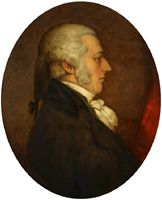
Nicholas Van Dyke
by Jefferson Davis Chalfant (1856 - 1931)
Oil on canvas, n. d.
Sight measurement
Height: 28 inches (71.1 cm)
Width: 23.5 inches (59.7 cm)
Signature (lower left): J.D. CHALFANT-
Cat. no. 32.00037.000
Biography of Nicholas Van Dyke, Jr.
This painting is one of two portraits of Nicholas Van Dyke
executed by Jefferson David Chalfant, a prominent Delaware
artist. In 1914 the great-granddaughters of Senator Van Dyke,
among whom was Mary Saulsbury, the wife of Delaware Senator
Willard Saulsbury, Jr., presented one of the paintings to
the U.S. Senate and the other to the state of Delaware. The
Delaware painting is currently in the collection of the state
of Delaware Bureau of Museums and Historic Sites. Early in
his career, Chalfant specialized in trompe l'oeil paintings,
for which he is best remembered. Although only about a dozen
of these still lifes exist, they are considered quite successful.
Originally a cabinetmaker from Chester County, Pennsylvania,
Chalfant spent the majority of his career in Wilmington, Delaware.
In 1890, under the sponsorship of a wealthy patron, Chalfant
went to Europe to receive formal art instruction at the Academie
Julian in Paris, where he studied human figure drawing. As
a result, Chalfant's focus shifted from still lifes to genre
scenes, and ultimately to portraiture after the turn of the
century. From 1905 to 1927 he painted portraits in the Wilmington
area with the support of Senator and Mrs. Saulsbury. The Smithsonian
Institution's Inventory of American Painting and Sculpture
lists 111 works by Chalfant. These are held by a variety of
individuals and institutions, including the Metropolitan Museum
of Art in New York City; the Delaware Art Museum in Wilmington,
Delaware;and Dartmouth College in Hanover, New Hampshire.
After suffering a stroke in 1927, the artist was forced to
give up painting. He died four years later.
Nicholas Van Dyke, a U.S. representative and senator, was born in New Castle, Delaware, and practiced law in his home state. His father had been a member of the Continental Congress and a signer of the Articles of Confederation, and Van Dyke eventually followed him into politics. After serving in the Delaware state legislature, Van Dyke was elected as a Federalist to the U.S. House of Representatives, where he served from 1807 to 1811. He then returned to the state senate, which eventually elected him to the U.S. Senate in 1817. Polished in manner and fluent in speech, Van Dyke became a prominent senator and chairman of the Committee on Pensions. He served in the U.S. Senate until his death in 1826.
For Further Information Please Visit This Site: http://www.senate.gov/