- Oil Painting »
- William Allison
William Allison
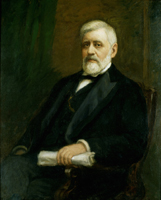
William Allison
by Wilbur Aaron Reaser (1860 - 1942)
Oil on canvas, 1908 ca.
Sight measurement
Height: 41.63 inches (105.7 cm)
Width: 33.63 inches (85.4 cm)
Signature (lower right corner): W.A. REASER
Cat. no. 32.00004.000
Biography of William Boyd Allison
Soon after William Allison's death, the Senate passed a resolution
authorizing the Joint Committee on the Library to memorialize
their former colleague. An existing oil portrait of Allison
by Wilbur Reaser was immediately purchased from the artist.
Nothing is known about the circumstances under which Reaser
came to paint Allison's portrait.
Like Allison, Reaser was born in Ohio but later moved to Iowa.
He studied drawing and painting at the San Francisco Art Institute
and at the Academies Julian and Colarossi in Paris. The artist
won gold and silver medals at the California Exposition in
1894 and a prize at New York's National Academy of Design
in 1896. He became a successful painter of public figures.
In addition to his portrait of Senator Allison, Reaser executed
likenesses of Senator Carroll Smalley Page, held by the Statehouse
of Vermont; Secretary of Agriculture James Wilson, located
at the State Historical Society of Iowa in Des Moines; and
Rutgers University President Merrill Edward Gates, owned by
Amherst College in Massachusetts.
Although he was born in Ashland County, Ohio, William Boyd Allison served Iowa as a U.S. representative and senator for 43 years. After helping to found the Ohio Republican Party, but losing a bid for prosecuting attorney for Ashland County, Allison moved to Iowa in 1857. He was elected to the U.S. House of Representatives in 1862 and served four terms. In 1872 Allison succeeded in his bid for the U.S. Senate, where he served continuously from 1873 until his death.
A political moderate and a master of conciliation, Allison helped frame successful tariff compromises and steered a middle course between protectionism and reform. Representing Midwest farmers, he sought to reduce tariffs on the manufactured goods they needed in quantity. In the currency debate then sweeping the nation, Allison successfully balanced conservative and inflationist demands by offering an amended version of a House bill proposed by Congressman Richard P. Bland of Missouri. Allison weakened Bland's bill, which provided for free and unlimited coinage of silver, to one that allowed specific limited coinage. Allison's version became the Bland-Allison Act of 1878.
For some twenty-five years Allison chaired the Senate Appropriations Committee. In 1897 he succeeded John Sherman of Ohio as chairman of the Republican caucus. Allison declined cabinet posts in the administrations of Presidents Garfield, Harrison, and McKinley, preferring to exert national leadership from the Senate. He won his state's Senate primary in June 1908, but he died in Dubuque, Iowa shortly thereafter.
For Further Information Please Visit This Site: http://www.senate.gov/