- Oil Painting »
- Willie Mangum
Willie P. Mangum
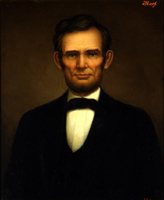
Willie P. Mangum
by James Reid Lambdin (1807 - 1889)
Oil on canvas, 1844
Sight measurement
Height: 29.88 inches
(75.9 cm)
Width: 24.25 inches (61.6
cm)
Unsigned
Cat. no. 32.00022.000
Biography of Willie Person Mangum
Willie P. Mangum was president pro tempore of the Senate when
this portrait by James Reid Lambdin was painted. The work
was apparently commissioned by Mangum or his family because
it was sent to Walnut Hall, Mangum's home in North Carolina,
shortly after it was executed. The painting remained in the
Mangum family until it was acquired by the Senate in 1978.
According to correspondence in the Willie Person Mangum Papers
at the Library of Congress, Lambdin asked to use a committee
room in the basement of the U.S. Capitol as a studio whenever
the space was free. Permission was granted in early March
1844, and Lambdin soon wrote Mangum to arrange for sittings.
The work was finished in three months. Mangum's magnetic personality,
charm, and political acumen, as reported by his contemporaries,
are effectively captured by Lambdin. Seated on a chair, the
senator looks steadily at the viewer, his straight mouth,
aquiline nose, and broad forehead conveying intelligence and
dignity. Only the warm flesh tones and the slight elegance
of the curls ornamenting his right temple modify this direct
depiction. A prolific painter, James Reid Lambdin was born
in Pittsburgh, Pennsylvania, studied in Philadelphia with
Thomas Sully, and returned to his native city in 1827.
There, in the manner of Charles Willson Peale, Lambdin painted
portraits and established a private museum containing both
art and natural history. Beginning in 1859, he served on the
commission to oversee the decoration of the U.S. Capitol extension.
He was the father of artist George Cochran Lambdin, who was
admired for his still-life paintings.
Willie Person Mangum was born in Orange (now Durham) County, North
Carolina. He studied law, became a superior court judge, served
in the U.S. House of Representatives from 1823 to 1826, and moved
to the U.S. Senate in 1831. Originally a Jacksonian Democrat, Mangum
opposed protective tariffs and instead supported states' rights.
In 1834, he broke with Andrew Jackson over several issues, especially
the removal of federal deposits from the Bank of the United States.
Mangum resigned from the Senate in 1836 after refusing to carry
out voting instructions from the North Carolina legislature, which
the Democrats controlled.
His political views were particularly well received in South Carolina,
where he won all 11 electoral votes for president of the United
States in the 1836 election. Mangum was elected in 1840 as a Whig
to fill the Senate vacancy caused by the resignation of Bedford
Brown. He was subsequently reelected and served until 1853. As president
pro tempore of the Senate between May 1842 and March 1845, he was
(under rules of the time) next in line for the presidency since
President John Tyler did not have a vice president. Mangum was an
astute political leader, an effective debater, and a powerful campaigner
with personal charm and magnetism. A close friend of Daniel Webster's,
Mangum helped persuade the Massachusetts senator to make his famous
"Seventh of March" speech during the Compromise of 1850 debates.
When he failed to win reelection in 1852, Mangum returned to North
Carolina, where he practiced law until his death in 1861.
For Further Information Please Visit This Site: http://www.senate.gov/