- Oil Painting »
- Uncle Sam's Money
Spending Uncle Sam's Money
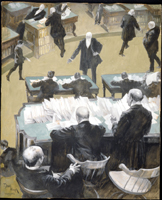
Spending Uncle Sam's Money
by T. Dart Walker (1869 - 1914)
Watercolor on board, 1899 ca.
Image measurement
Height: 23 inches (58.4
cm)
Width: 18.5 inches (47
cm)
Signature (lower left corner): T. DART. / WALKER / WASHINGTON
Cat. no. 34.00002.000
More on Spending Uncle Sam's Money
This view of the Senate Chamber was painted by T. Dart Walker
in the late 1890s after observing a busy congressional work
day. The scene was then engraved for the front cover of the
December 23, 1899, issue of Leslie's Weekly and titled Spending
Uncle Sam's Money: Senators Introducing the Customary Batch
of Miscellaneous Bills at the Opening of the Session of Congress.
Walker was born in Indiana, studied in Paris, and was known
as an illustrator and marine artist. His work appeared in
popular magazines of the period, such as Harper's Weekly,
the Graphic, and the Illustrated London News, and included
scenes of political life, national events, and everyday activities.
This scene, painted in the late 1890s, depicts the U.S. Senate Chamber
as it appeared at the opening of a session of Congress. Senators
have just introduced the various bills to be considered during the
session, and the large number of papers indicates that a heavy workload
lies before them. New York illustrator T. Dart Walker captured the
scene from the press gallery located on the north side of the Chamber.
Below this gallery, but not illustrated, is the rostrum where the
presiding officer of the Senate sits.
Until recent years the vice president of the United States, as president
of the Senate, presided regularly over Senate debates from this
vantage point. In the center of the painting three Senate staff
members sit in front of the presiding officer's desk. Most likely
these men are, from left to right, the secretary of the Senate,
the legislative clerk, and the reading clerk. Immediately in front,
at two smaller tables below the rostrum, sit official reporters
and press reporters. Meanwhile, in the background, senators talk
with one another in the "well" of the Chamber or at their desks,
which are arranged in a semi-circle with Republicans on the left
and Democrats on the right.
Two Senate pages appear in the scene: One is seated below the clerks'
desk, and another crosses the Senate floor. The position of Senate
page was first created in 1829. By the turn of the century the Senate
employed at least 17 young boys as pages. Dressed in blue knickers
and jackets, the pages spent their days running errands for the
senators, announcing impending votes, placing papers and pens on
the senators' desks, and delivering messages throughout the city.
For Further Information Please Visit This Site: http://www.senate.gov/