- Oil Painting »
- Gen Paul
Gen Paul
Gen Paul (July 2, 1898-April 30, 1975), was a French painter and engraver.
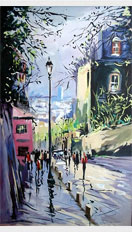
Born as Eugene Paul in a house in Montmartre on the Rue Lepic painted by Van Gogh, he began drawing and painting as a child. His father died when he was only ten years old and Gen Paul was trained to work in decorative furnishings. He served in the French army during World War I and was wounded twice, losing one of his legs. During his convalescence he returned to painting, and at Le Bateau-Lavoir he became friends with Juan Gris who helped him a great deal. Although Gen Paul never received any formal training, he made a living from his art for almost 60 years.
Gen Paul first exhibited at the Salon d'Automne and the Salon des Independants in Paris in 1920. In 1928, his works were exhibited with those of Pablo Picasso and Chaim Soutine. Gen Paul began the 1930s with a serious addition to alcohol that added to his already severe health problems.
In 1934, he was recognized for his contributions to France and was awarded the Legion of Honor. In 1937 he was contracted to paint a large fresco for the Pavilion of Wines of France at the Paris International Exposition.
In addition to painting scenes from his native Montmartre, including that of his friend, composer Darius Milhaud, Gen Paul traveled to the United States where he painted jazz and classical musicians, a subject with which he had much interest.
Gen Paul passed away at the Hospital of Pity-Salpetriere in Paris in 1975 and was interred in the Cimetiere Saint-Vincent in Montmartre. A great many of his works remain in private hands but a number of his important pieces can be found at museums in France and in other parts of Europe.