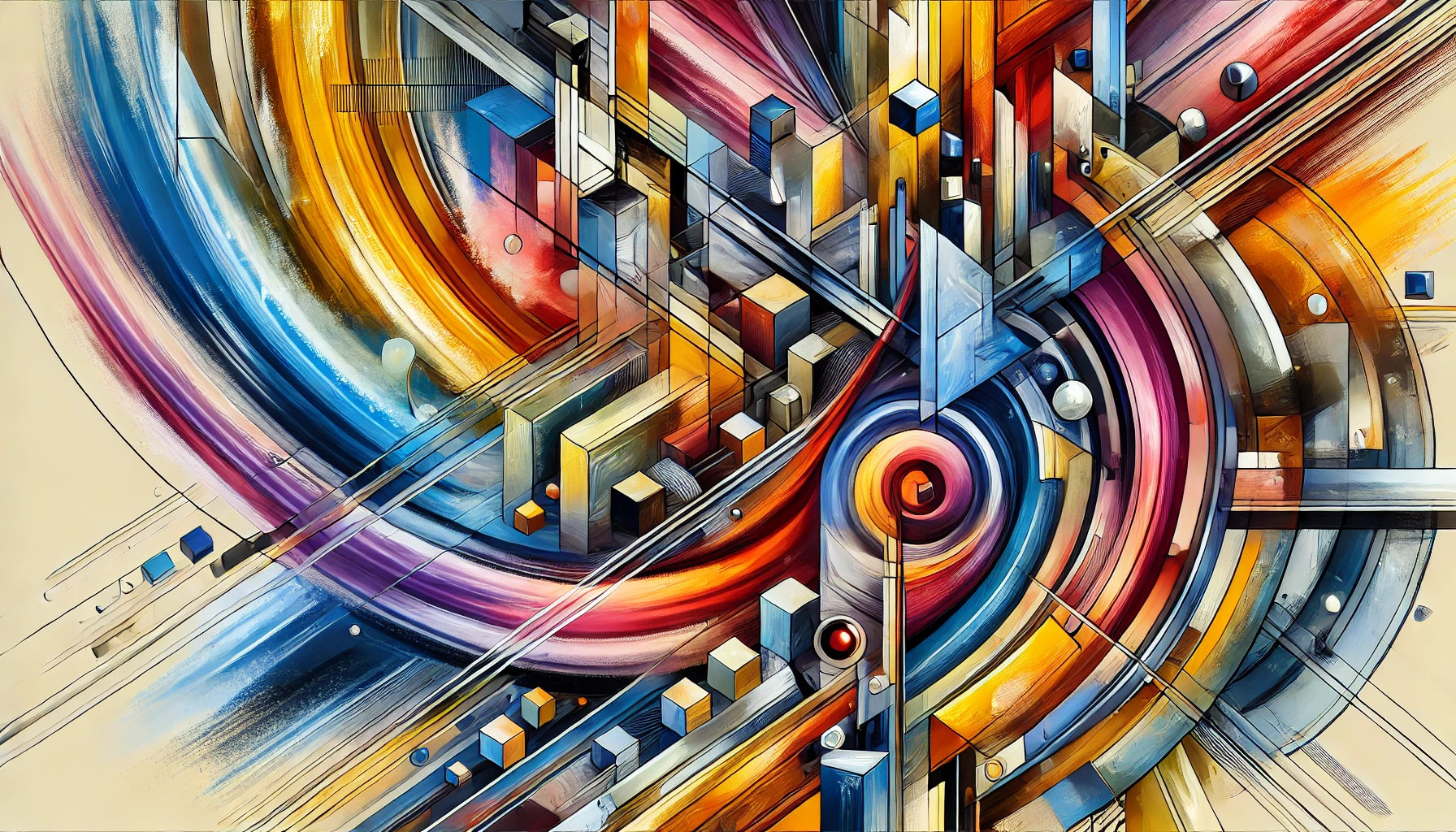
Abstract art is now generally understood to mean art that does not depict objects in the natural world, but instead uses shapes and colors in a non-representational or subjective way. In the very early 20th century, the term was more often used to describe art, such as Cubist and Futurist art, that depicts real forms in a simplified or rather reduced way keeping only an allusion of the original natural subject. Such paintings were often claimed to capture something of the depicted objects immutable intrinsic qualities rather than its external appearance.The term non-figurative is used as a synonym.
Non-objective art is not an invention of the twentieth century. In the Jewish and Islamic religion the depiction of human beings was not allowed. Consequently the Islamic and Jewish cultures developed a high standard of decorative arts. Calligraphy is also a form of non-figurative art. Abstract designs have also existed in western culture in many contexts. However, Abstract art is distinct from pattern-making in design, since it draws on the distinction between decorative art and fine art, in which a painting is an object of thoughtful contemplation in its own right.
Even before the widespread use of photography some artists, such as James McNeill Whistler were placing greater emphasis on visual sensation than the depiction of objects. Whistler argued that art should concern itself with the harmonious arrangement of colors, just as music deals with the harmonious arrangement of sounds. Whistler's painting Nocturne in Black and Gold: The Falling Rocket (1874) is often seen as a major move towards abstraction. Later artists such as Wassily Kandinsky argued that modern science dealt with dynamic forces, revealing that matter was ultimately spiritual in character: art should display the spiritual forces behind the visual world. Many of these artists were influenced by esotericist movements such as theosophy, in which abstract "thought forms" were used to illustrate the psychic forces supposedly generated by emotions, music and other events. The work of Wassily Kandinsky and Kasimir Malevich as well as Natalia Goncharova and Mikhail Larionov, are generally seen as the first fully abstract paintings in 1911. Movements in modern art are to be considered in terms of the concepts which they exemplify, accompanied as they were by manifestos and declarations.
Constructivism (1915) and De Stijl (1917) were parallel movements which took abstraction into the three dimensions of sculpture and architecture. The Constructivists believed that the artist's work was a revolutionary activity, to express the aspirations of the people, using machine production and graphic and photographic means of communication. Some of the American Abstract Expressionists are purely abstract and include : Barnett Newman, Mark Rothko and Robert Motherwell. Op Art (1962) and Minimalism (1965)[2] are the most recent idioms. It is, at present, more likely that an artist's work is seen as an individual entity rather than part of a movement. Sean Scully, John McLaughlin, Callum Innes, Robert Stark and Yuko Shiraishi are some abstract painters of today.